10-K: Annual report [Section 13 and 15(d), not S-K Item 405]
Published on April 1, 2026
UNITED STATES
SECURITIES AND EXCHANGE COMMISSION
WASHINGTON, DC 20549
FORM
FOR
THE FISCAL YEAR ENDED
FOR THE TRANSITION PERIOD FROM _______ TO _______
COMMISSION
FILE NUMBER:
(Exact name of registrant as specified in its charter)
| (State or other jurisdiction of | (IRS Employer | |
| incorporation or organization) | Identification No.) |
(Address and Zip Code of principal executive offices)
(Registrant’s
telephone number, including area code):
Securities registered pursuant to Section 12(b) of the Act:
| Title of each class | Trading symbol(s) | Name of each exchange on which registered | ||
Indicate
by check mark if the registrant is a well-known seasoned issuer, as defined in Rule 405 of the Securities Act. Yes ☐
Indicate
by check mark if the registrant is not required to file reports pursuant to Section 13 or Section 15(d) of the Act. Yes ☐
Indicate
by checkmark whether the registrant: (1) has filed all reports required to be filed by Section 13 or 15(d) of the Securities Exchange
Act of 1934 during the preceding 12 months (or for such shorter period that the registrant was required to file such reports), and (2)
has been subject to such filing requirements for the past 90 days.
Indicate
by check mark whether the registrant has submitted electronically every Interactive Data File required to be submitted pursuant to Rule
405 of Regulation S-T (§232.405 of this chapter) during the preceding 12 months (or for such shorter period that the registrant
was required to submit such files). ☒
Indicate by check mark whether the registrant is a large accelerated filer, an accelerated filer, a non-accelerated filer, smaller reporting company, or an emerging growth company. See the definitions of “large accelerated filer,” “accelerated filer,” “smaller reporting company,” and “emerging growth company” in Rule 12b-2 of the Exchange Act.
| Large accelerated filer | ☐ | Accelerated filer | ☐ |
| ☒ | Smaller reporting company | ||
| Emerging growth company | |||
If
an emerging growth company, indicate by check mark if the registrant has elected not to use the extended transition period for complying
with any new or revised financial accounting standards provided pursuant to Section 13(a) of the Exchange Act.
Indicate
by check mark whether the registrant has filed a report on and attestation to its management’s assessment of the effectiveness
of its internal control over financial reporting under Section 404(b) of the Sarbanes-Oxley Act (15 U.S.C. 7262(b)) by the registered
public accounting firm that prepared or issued its audit report.
If
securities are registered pursuant to Section 12(b) of the Act, indicate by check mark whether the financial statements of the registrant
included in the filing reflect the correction of an error to previously issued financial statements.
Indicate by check mark whether any of those error corrections are restatements that required a recovery analysis of incentive-based compensation received by any of the registrant’s executive officers during the relevant recovery period pursuant to § 240.10D-1(b). ☐
Indicate
by check mark whether the registrant is a shell company (as defined in Rule 12b-2 of the Act). Yes ☐ No
The
aggregate market value of the registrant’s common stock held by non-affiliates was $
As of March 31, 2026, Amaze Holdings, Inc. had shares of common stock outstanding.
DOCUMENTS INCORPORATED BY REFERENCE
TABLE OF CONTENTS
| i |
EXPLANATORY NOTE
On March 7, 2025, Fresh Vine Wine, Inc. (“Fresh Vine” and after the acquisition described herein, “Amaze Holdings, Inc.”) completed the acquisition of Amaze Software, Inc. (the Acquisition”), pursuant to the Amended and Restated Agreement and Plan of Merger dated as of March 7, 2024 (the “Merger Agreement”) by and among Fresh Vine, Amaze Holdings Inc., a Delaware corporation and wholly owned subsidiary of the Company (“Merger Sub”), Amaze Software, Inc., a Delaware corporation (“Amaze Software”), the stockholders of Amaze Software listed on Schedule I thereto (each, a “Holder” and together the “Holders”), and Aaron Day, solely in his capacity as the Holders’ Representative (the “Holders’ Representative”). Amaze Software is an end-to-end, creator-powered commerce platform offering tools for seamless product creation, advanced e-commerce solutions, and scalable managed services. Effective March 24, 2025 (the “Effective Date”), Fresh Vine was renamed “Amaze Holdings, Inc.” (“Amaze”).
Unless the context requires otherwise, references in this Annual Report to “Company,” “we,” “us” and “our” refer to Fresh Vine prior to the Effective Date and to Amaze Holdings, Inc. and its subsidiaries following the Effective Date, and references to “Amaze Software” refer Amaze Software, Inc.
The Company’s common stock is listed on the NYSE American under the symbol “AMZE” as of the Effective Date.
Cautionary Statement Concerning Forward-Looking Statements
We make forward-looking statements in this Annual Report on Form 10-K. Such forward-looking statements include, but are not limited to, statements concerning our strategies, future operations, future financial position and operating results, capital adequacy, growth opportunities, prospects, and plans and objectives of our management team. In addition, any statements that refer to projections, forecasts or other characterizations of future events or circumstances, including any underlying assumptions, are forward-looking statements. In some cases, you can identify these statements by forward-looking words such as “may,” “might,” “should,” “would,” “could,” “expect,” “plan,” “anticipate,” “intend,” “believe,” “estimate,” “predict,” “potential” or “continue,” and the negative of these terms and other comparable terminology. The forward-looking statements contained in this Annual Report on Form 10-K are based on current expectations and beliefs concerning future developments and their potential effects on us. There can be no assurance that future developments affecting us will be those that we have anticipated. These forward-looking statements involve a number of risks, uncertainties (some of which are beyond our control) or other assumptions that may cause actual results or performance to be materially different from those expressed or implied by these forward-looking statements. These risks and uncertainties include, but are not limited to, those factors described below and under the heading “Risk Factors.”
| ● | We have a history of losses from operations and there are no assurances we will report profitable operations in future periods or continue as a going concern. | |
| ● | We will require additional capital to fund our operations and growth, and we may be unable to obtain financing on acceptable terms or at all. | |
| ● | Substantial indebtedness could adversely affect our financial condition, limit our ability to raise additional capital to fund our operations and prevent us from fulfilling our obligations under our indebtedness. | |
| ● | We are heavily reliant on third-party suppliers to provide goods to our clients and disruptions in the supply chain could adversely affect our business. | |
| ● | We depend on third-party platforms, and changes in platform popularity, algorithms, policies or access could adversely affect our business. | |
| ● | Our brand success may rely on the reputation of our clients’ brands, which could be adversely affected by the actions of our clients. | |
| ● | Unfavorable economic conditions may lead to a decrease in discretionary spending and which could adversely affect the demand for our clients’ products and content. | |
| ● | Our success and growth depend, in part, on attracting new clients and we may not be successful in doing so. | |
| ● | We have relationships with suppliers outside of the United States and the imposition of tariffs may increase our costs and adversely affect our business. | |
| ● | We rely on third-party payment processors and are exposed to risks relating to payment failures, fraud, chargebacks and other transaction-related losses. | |
| ● | We face intense competition and may not be able to compete effectively. | |
| ● | Our revenue growth rate and financial performance have fluctuated, which makes it difficult to predict the future success of our business operations. | |
| ● | Our future success depends on the continuing efforts of our management and key employees, and on our ability to attract and retain highly skilled personnel and senior management. | |
| ● | If we fail to comply with United States and foreign laws related to privacy, data security, and data protection, it could adversely affect our operating results and financial condition. | |
| ● | We may be subject to litigation which could result in significant costs and liabilities and have a material adverse effect on our business operations. |
| ii |
Should one or more of these risks or uncertainties materialize, or should any of our assumptions prove incorrect, actual results may vary in material respects from those projected in these forward-looking statements. Some of these risks and uncertainties may in the future be amplified by a global crises and/or any response to such a crisis and there may be additional risks that we consider immaterial or which are unknown. It is not possible to predict or identify all such risks. We do not undertake any obligation to update or revise any forward-looking statements, whether as a result of new information, future events or otherwise, except as may be required under applicable securities laws.
This Annual Report on Form 10-K includes market data and forecasts with respect to the wine industry. We have obtained this market data and certain industry forecasts from various independent third-party sources, including industry publications, reports by market research firms, surveys, and other independent sources. Some data and information are based on management’s estimates and calculations, which are derived from our review and interpretation of internal company research and data, surveys, and independent sources. We believe the data regarding the industry in which we compete and our market position and market share within this industry generally indicate size, position, and market share within this industry; however, this data is inherently imprecise and is subject to significant business, economic and competitive uncertainties and risks due to a variety of factors, including those described in “Risk Factors.” These and other factors could cause our future performance to differ materially from our assumptions and estimates.
In addition, statements that “we believe” and similar statements reflect our beliefs and opinions on the relevant subject. These statements are based on information available to us as of the date of this report. Although we believe that information provides a reasonable basis for these statements, that information may be limited or incomplete. Our statements should not be read to indicate that we have conducted an exhaustive inquiry into, or review of, all relevant information. These statements are inherently uncertain, and investors are cautioned not to unduly rely on these statements.
| iii |
PART I
ITEM 1. BUSINESS.
Overview
Amaze Holdings, Inc. (formerly Fresh Vine Wine, Inc.) is a technology-enabled, creator-powered commerce platform that enables creators, brands, and consumers to transact at scale. Following the acquisition of Amaze Software, Inc. in March 2025, the Company transitioned its primary business from a consumer-packaged goods company into a software-driven commerce, data, and distribution platform for the creator economy.
The Company’s platform provides end-to-end infrastructure for creators and brands to design, launch, market, and fulfill products, while capturing high-value, first-party transaction data. The Company operates an asset-light model, leveraging third-party manufacturing, logistics, and payment partners to support scalable commerce operations.
The Company currently operates in two segments:
| ● | E-commerce / Subscriptions (Core Business) – includes the Amaze platform, creator commerce operations, and related data and distribution initiatives | |
| ● | Wine Products (Non-Core) – includes the legacy Fresh Vine wine business |
While the Company continues to operate its wine segment, it is no longer a strategic focus and is not expected to be a material driver of long-term growth.
Recent Developments
Agreement and Plan of Merger
On March 7, 2025, Fresh Vine completed the acquisition of Amaze Software, Inc., pursuant to an Amended and Restated Agreement and Plan of Merger dated as of March 7, 2025 (the “Merger Agreement”) by and among Fresh Vine, Amaze Holdings Inc., a Delaware corporation and wholly owned subsidiary of Fresh Vine (“Merger Sub”), Amaze Software, Inc., a Delaware corporation (“Amaze Software”), the stockholders of Amaze Software listed on Schedule I thereto (each, a “Holder” and together the “Holders”), and Aaron Day, solely in his capacity as the Holders’ Representative (the “Holders’ Representative”). Amaze Software is an end-to-end, creator-powered commerce platform offering tools for seamless product creation, advanced e-commerce solutions, and scalable managed services.
Pursuant to the Merger Agreement, (i) Merger Sub merged with and into Amaze Software (the “Merger”) with Amaze Software as the surviving company and a wholly owned subsidiary of Fresh Vine, and (ii) the aggregate merger consideration paid by Fresh Vine in connection with the acquisition included 750,000 shares of the Fresh Vine’s Series D Convertible Preferred Stock, par value $0.001 per share (“Series D Preferred Stock”), plus warrants (the “Merger Warrants”) to purchase an aggregate of 380,448 shares of Fresh Vine’s common stock, par value $0.001 per share (the “Common Stock”).
Acquisition of The Food Channel
On November 7, 2025, the Company, through its wholly owned subsidiary Food Channel Amaze Company LLC, entered into an Asset Purchase Agreement pursuant to which it acquired substantially all of the assets of Foodchannel.com LLC, including its digital media platform, intellectual property, customer relationships, and related assets associated with the “Food Channel” brand. The transaction was structured as an asset purchase on a cash-free, debt-free basis with no post-closing working capital adjustment.
The Company acquired the assets in exchange for the issuance of a $650,000 convertible promissory note. The note accrues interest at a rate of 4% per annum and is convertible into shares of the Company’s common stock at a fixed conversion price of $0.76 per share. The note is convertible at the option of the holder at any time following issuance and converted into equity on January 6, 2026, together with any accrued and unpaid interest.
| 1 |
A portion of the purchase price, equal to 10%, is subject to a holdback for a period of twelve months following closing to secure potential indemnification obligations of the seller. The agreement contains customary representations, warranties, covenants, and indemnification provisions, including non-competition and non-solicitation obligations. In connection with the acquisition, certain principals of the seller entered into consulting arrangements with the Company to support the ongoing development and integration of the acquired business.
Our Existing Business
The Company operates a technology-enabled creator commerce platform that integrates commerce infrastructure, data generation, and distribution capabilities.
Platform Capabilities
The Amaze platform provides a comprehensive suite of tools that enable creators and brands to operate end-to-end digital commerce businesses. These capabilities include:
| ● | Creator storefronts and digital commerce tools that allow users to establish branded online presences and transact directly with consumers | |
| ● | Product design, merchandising, and catalog management functionality to support rapid product development and iteration | |
| ● | Integrated payment processing and order management systems | |
| ● | On-demand manufacturing capabilities and third-party fulfillment integration | |
| ● | Marketing, analytics, and performance optimization tools designed to enhance engagement and conversion |
The Company operates an asset-light model, leveraging a network of third-party suppliers and fulfillment partners to produce and deliver products. This approach reduces inventory risk, minimizes capital requirements, and enables the Company to scale efficiently while supporting a broad range of creators and product offerings.
Data and Monetization
A component of the Company’s evolving business model is the generation, and aggregation of first-party transaction data derived from activity across its platform. This data includes, among other things, consumer purchase behavior, product preferences and engagement metrics, creator-audience relationships, and certain geographic and demographic insights associated with transactions and platform usage.
The Company is in the early stages of developing capabilities to utilize this data to enhance platform performance and support additional monetization opportunities. These efforts are expected to focus on improving targeting and personalization to drive marketing efficiency and conversion rates for creators and brands. The Company is also evaluating opportunities to develop data-driven advertising and related solutions; however, these initiatives are in the initial stages of commercialization, and there can be no assurance as to the timing or extent of revenue generation from such activities.
Distribution Layer
The Company is in the early stages of expanding its platform through the development of verticalized distribution channels, including the Food Channel and other category-specific initiatives. These efforts are intended to organize creators and content within defined interest areas and to support more targeted engagement between creators, consumers, and brands.
| 2 |
As these channels are developed, the Company expects they may facilitate broader distribution of commerce offerings, support increased user engagement, and contribute to repeat transaction activity across the platform. In addition, these initiatives are intended to enhance the Company’s ability to generate and utilize data derived from platform activity. These distribution capabilities remain in development, and there can be no assurance as to the timing, scale, or extent of their impact on the Company’s operations or financial results.
Legacy Wine Business
The Company continues to operate its Fresh Vine wine business, which includes wholesale and direct-to-consumer distribution. This segment is not expected to be a material driver of future growth, and the Company may evaluate strategic alternatives.
Our Strengths
The Company believes its competitive strengths are derived from the combination of its technology platform, operating model, and data capabilities. While the Company is in a developing stage, management believes the following factors position it to support future growth and scalability:
Integrated Commerce Platform
The Company has developed an integrated platform that brings together key elements required to operate a digital commerce business, including storefront creation, product design and merchandising, payment processing, order management, and fulfillment coordination. By consolidating these functions into a single platform, the Company reduces operational complexity for creators and brands and enables faster time-to-market for new products. This integration also allows the Company to capture data across the full transaction lifecycle, which may support future optimization of performance and monetization.
Generation of First-Party Transaction Data
Through activity on its platform, the Company generates first-party data derived from actual consumer transactions and user interactions. This data includes purchase behavior, engagement patterns, and relationships between creators and their audiences. Unlike third-party data sources, which are subject to increasing regulatory and platform restrictions, the Company’s data is generated directly through its own platform operations and is tied to actual transaction activity. As platform usage increases, the Company expects the volume and depth of this data to expand, which may enhance its ability to improve platform performance and inform future product development. The Company believes that continued accumulation of first-party transaction data may, over time, contribute to a differentiated dataset that is not readily replicable without similar levels of platform activity and user engagement.
Asset-Light Operating Model
The Company operates an asset-light model by leveraging third-party partners for manufacturing, logistics, and fulfillment. This approach reduces the need for capital investment in inventory, production facilities, and supply chain infrastructure. As a result, the Company can offer a broad range of products without assuming significant inventory risk and can adjust product offerings more rapidly in response to consumer demand. This model is also intended to support scalability as transaction volume increases.
Creator and Brand Participation
The Company’s platform is designed to support a diverse base of creators and brands, ranging from independent digital entrepreneurs to emerging businesses. These participants utilize the platform to monetize their audiences through product sales and related offerings. As platform participation grows, the Company expects increased transaction volume and engagement, which may contribute to reinforcing effects between creators, consumers, and platform activity over time. The Company believes that sustained creator participation, combined with transaction-driven data generation, may increase the relative value of the platform to its users. However, the Company’s ability to attract and retain creators and brands remains a key factor in its future performance.
| 3 |
Expanding Distribution Capabilities
The Company has begun developing verticalized distribution channels, including the Food Channel, which are intended to organize creators and content within specific categories and provide additional pathways for audience engagement. These initiatives are in early stages and are designed to support increased visibility of creator offerings, enhance consumer engagement, and potentially improve transaction frequency. The Company believes that, over time, such distribution channels may complement its core commerce platform and support broader monetization opportunities, although their impact remains subject to execution and market adoption.
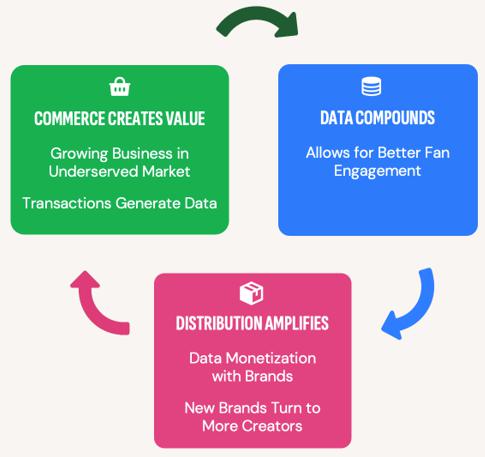
Flywheel-Driven Value Creation
The Company’s business model is designed to benefit from a reinforcing relationship between its commerce activity, data generation, and platform optimization capabilities. As transactions occur on the platform, the Company generates first-party data derived from consumer behavior and engagement. The Company utilizes these insights to inform platform improvements, including enhancements to user experience, merchandising, and engagement strategies.
Over time, the Company expects that increases in platform usage may enhance the scale and utility of its data assets, which in turn may support improved targeting, personalization, and conversion. These improvements are intended to drive additional transaction activity, further increasing data generation and platform utilization. The Company believes that, if successfully executed, this dynamic may contribute to increasing platform efficiency and scalability over time.
While elements of this model are currently in operation, the broader impact of this reinforcing dynamic remains dependent on the Company’s ability to scale platform usage and effectively utilize its data. There can be no assurance as to the extent or timing of these potential benefits.
Exhibit: Amaze Flywheel
| 4 |
Strategy for Growth
The Company’s strategy is focused on expanding its platform capabilities and increasing monetization across its commerce operations while developing additional data and distribution-driven opportunities. While certain elements of this strategy are currently in operation through the Company’s existing commerce platform, other components remain in development and are expected to evolve over time.
Expand Creator and Brand Participation
The Company’s platform is designed to support a growing base of creators and brands who utilize its tools to launch and manage commerce offerings. The Company continues to invest in user acquisition, onboarding, and platform functionality to increase participation and engagement. Growth in the number of active creators and brands is expected to contribute to increased transaction volume and broader platform adoption. The Company’s ability to expand its user base will depend on continued product development, competitive positioning, and market acceptance.
Enhance Data Utilization and Monetization Capabilities
The Company generates first-party data through transaction activity on its platform and is in the early stages of developing capabilities to utilize this data more effectively. Current efforts are focused on improving platform performance, including merchandising decisions and user engagement. Over time, the Company intends to expand these capabilities to support additional monetization opportunities, including data-driven marketing, analytics, and advertising-related solutions. These initiatives are in development, and their timing and impact will depend on successful execution and market adoption.
Build and Scale Distribution Channels
The Company has begun developing verticalized distribution channels, including the Food Channel, which are intended to organize creators and content within specific categories and provide additional pathways for consumer engagement. These channels are expected to complement the Company’s core commerce platform by increasing visibility of creator offerings and supporting demand generation. These initiatives are in early stages, and their ability to scale will depend on content development, user adoption, and the Company’s ability to effectively integrate distribution with its commerce infrastructure.
Increase Monetization per Transaction
The Company seeks to improve revenue per user and per transaction through optimization of pricing structures, product offerings, and platform services. Current efforts include refining product mix, enhancing merchandising capabilities, and improving conversion rates through platform enhancements. As the Company continues to develop additional capabilities, including data-driven features and distribution channels, it expects that monetization opportunities per transaction may increase; however, these outcomes are dependent on successful implementation and user adoption.
Pursue Strategic Partnerships and Acquisitions
The Company evaluates opportunities to expand its platform capabilities and market reach through strategic partnerships and acquisitions. Recent activities, including the acquisition of Food Channel assets, reflect the Company’s approach to acquiring complementary assets that support its commerce and distribution strategy. The Company expects to continue to pursue opportunities that enhance its technology, data capabilities, or distribution reach, although there can be no assurance that such opportunities will be identified or successfully executed.
| 5 |
Improve Unit Economics and Operating Efficiency
The Company’s asset-light operating model provides flexibility to scale without significant capital investment. The Company continues to focus on improving operational efficiency, including supplier relationships, fulfillment processes, and platform performance. As transaction volume increases, the Company expects to benefit from operating leverage; however, the extent of these benefits will depend on the Company’s ability to manage costs and execute its growth initiatives effectively.
Competition
The Company operates in highly competitive and rapidly evolving markets, including creator commerce, e-commerce enablement, and digital advertising.
In the e-commerce enablement category, the Company competes with platforms such as Shopify, WooCommerce, and similar providers that offer tools for storefront creation, payment processing, and online commerce infrastructure. These platforms are generally well-established and may offer extensive ecosystems of integrations and services.
Within the creator monetization space, the Company competes with platforms such as Patreon and other services that enable creators to generate revenue from their audiences through subscriptions, merchandise, and related offerings. These platforms may benefit from established user bases and brand recognition.
The Company also competes with print-on-demand and fulfillment providers that offer product creation and logistics services, either as standalone solutions or as components of broader commerce platforms. These providers may compete on factors such as cost, production capabilities, and fulfillment speed.
In addition, the Company faces competition from digital advertising and data platforms, including large technology companies and advertising networks that provide targeting, analytics, and monetization solutions. Many of these competitors have greater financial resources, larger datasets, and more developed advertising ecosystems.
The Company is also beginning to compete with emerging platforms that seek to integrate commerce, creator tools, and data-driven monetization into unified offerings. These platforms may pursue strategies similar to the Company’s and could compete for creators, brands, and consumer engagement as the market continues to evolve.
The Company competes based on:
| ● | Ease of use and platform functionality | |
| ● | Data capabilities and targeting effectiveness | |
| ● | Creator and brand relationships | |
| ● | Pricing and economics | |
| ● | Ability to provide integrated commerce, data, and distribution solutions |
Management believes the Company’s integrated approach and first-party data capabilities differentiate it from competitors; however, competition remains intense and evolving.
IT Systems
We rely on various IT systems, owned by us and third parties, to effectively manage our sales and marketing, accounting, financial, legal and compliance functions. Our website is hosted by a third party, and we rely on third-party vendors for regulatory compliance for order processing, shipments, and e-commerce functionality. We believe these systems are scalable to support our growth plans. We recognize the value of enhancing and extending the uses of information technology in our business.
| 6 |
Regulatory Matters
The Company is subject to a variety of U.S. federal, state, and international laws and regulations, including those related to:
| ● | Data privacy and protection (e.g., CCPA, GDPR and similar frameworks) | |
| ● | Consumer protection and e-commerce regulations | |
| ● | Advertising and marketing practices | |
| ● | Payment processing and financial transactions | |
| ● | Intellectual property and content rights |
Data privacy and protection
We collect personal information from individuals. Accordingly, we are subject to several data privacy and security related regulations, including but not limited to: U.S. state privacy, security and breach notification laws; the GDPR; and other European privacy laws as well as privacy laws being adopted in other regions around the world. In addition, the FTC and many state attorneys general are interpreting existing federal and state consumer protection laws to impose evolving standards for the online collection, use, dissemination and security of information about individuals. Certain states have also adopted robust data privacy and security laws and regulations. For example, the CCPA, which took effect in 2020, imposes obligations and restrictions on businesses regarding their collection, use, and sharing of personal information and provides new and enhanced data privacy rights to California residents, such as affording them the right to access and delete their personal information and to opt out of certain sharing of personal information. In response to the data privacy laws and regulations discussed above and those in other countries in which we do business, we have implemented several technological safeguards, processes, contractual third-party provisions, and employee trainings to help ensure that we handle information about our employees and customers in a compliant manner. We maintain a global privacy policy and related procedures, and we train our workforce to understand and comply with applicable privacy laws.
Consumer protection and e-commerce regulations
The Company conducts business directly with consumers through its platform and is therefore subject to a variety of U.S. federal, state, and international consumer protection and e-commerce laws and regulations. These include, but are not limited to, laws governing online sales practices, pricing disclosures, automatic renewals, refunds and returns, subscription services, shipping and fulfillment obligations, and unfair or deceptive trade practices. In the United States, the Federal Trade Commission (“FTC”) and state attorneys general enforce many of these laws, including those that prohibit unfair, deceptive, or misleading business practices.
In addition, certain states have enacted specific e-commerce and consumer protection statutes that impose additional requirements on businesses, including disclosure obligations and restrictions on subscription-based services. The Company is also subject to international laws and regulations governing online commerce in jurisdictions where it operates, which may impose additional compliance requirements related to consumer rights, contract formation, and digital transactions.
As the Company’s platform enables creators and third parties to sell products directly to consumers, the Company may also be subject to regulatory scrutiny regarding its role in facilitating these transactions, including obligations related to product representations, customer communications, and dispute resolution. The Company has implemented policies, procedures, and platform controls intended to promote compliance with applicable consumer protection laws; however, evolving regulatory interpretations and increased enforcement activity may require ongoing updates to these practices. Failure to comply with applicable laws and regulations could result in investigations, fines, penalties, or reputational harm.
| 7 |
Advertising and Marketing Practices
The Company is subject to a variety of laws and regulations governing advertising, marketing, and promotional activities. These include federal and state laws in the United States, as well as international regulations, that prohibit false, misleading, or deceptive advertising and require that marketing communications be truthful, substantiated, and clearly disclosed. The FTC, state regulators, and international authorities actively enforce these requirements.
The Company’s platform may be used by creators and brands to promote and market products to consumers. As a result, the Company may be subject to regulatory scrutiny related to advertising claims, influencer marketing practices, and the disclosure of material relationships between creators and brands. For example, applicable regulations may require clear and conspicuous disclosure of sponsored content, endorsements, or other commercial relationships.
In addition, the Company may be subject to laws governing digital marketing practices, including email marketing (such as the CAN-SPAM Act), mobile messaging, and other forms of direct or targeted communication. The Company has implemented policies and guidelines intended to promote compliance with applicable advertising and marketing regulations, including standards related to disclosures and content review; however, compliance may depend in part on the actions of third-party creators and partners using the platform.
As regulatory expectations and enforcement priorities continue to evolve, particularly in the areas of influencer marketing and digital advertising, the Company may be required to update its practices and controls. Non-compliance could result in regulatory action, financial penalties, or reputational harm.
Payment Processing and Financial Transactions
The Company facilitates payments between consumers and creators through its platform and is therefore subject to laws and regulations governing payment processing, financial transactions, and related activities. These include federal and state laws in the United States, as well as international regulations, that apply to electronic payments, money transmission, anti-money laundering (“AML”), and counter-terrorism financing.
The Company relies on third-party payment processors and financial institutions to process transactions, manage payment authorization and settlement, and provide related services. These third-party providers are subject to their own regulatory requirements and may impose contractual obligations on the Company, including compliance with payment card network rules, such as those established by Visa, Mastercard, and other payment networks.
In certain jurisdictions, the Company’s activities may be subject to laws governing money transmission or similar financial services, depending on how funds are received, held, and disbursed. The Company has structured its operations to rely on third-party providers for regulated payment services; however, regulatory interpretations in this area may evolve and could impact the Company’s compliance obligations.
In addition, the Company is subject to data security standards related to payment processing, including the Payment Card Industry Data Security Standard (“PCI DSS”). The Company maintains controls and works with third-party providers to support compliance with applicable requirements; however, failures in payment processing systems, security breaches, or non-compliance with applicable regulations could result in financial loss, regulatory penalties, or operational disruption.
| 8 |
Intellectual Property and Content Rights
The Company’s business involves the creation, distribution, and commercialization of content and products associated with creators and brands, and is therefore subject to laws and regulations governing intellectual property and content rights. These include U.S. and international laws related to copyrights, trademarks, patents, and rights of publicity, as well as contractual obligations associated with content licensing and use.
The Company’s platform enables creators to upload, design, and sell products and content, which may incorporate intellectual property owned by the creators or third parties. As a result, the Company may be exposed to claims of intellectual property infringement, including unauthorized use of copyrighted materials, trademarks, or other proprietary rights. The Company has implemented policies and procedures intended to address such risks, including processes for responding to claims under the Digital Millennium Copyright Act (“DMCA”) and similar frameworks.
The Company also relies on contractual arrangements with creators, partners, and third-party service providers to define ownership, licensing, and permitted use of intellectual property. These arrangements are intended to clarify rights and responsibilities; however, disputes may arise regarding ownership, usage rights, or infringement.
In addition, the Company’s brands, trademarks, and proprietary technology are important to its business. The Company seeks to protect these assets through a combination of trademark registrations, contractual protections, and internal controls. Despite these efforts, unauthorized use or infringement of the Company’s intellectual property could occur, and the Company may be required to enforce its rights through litigation or other means.
As the Company expands its platform and distribution capabilities, including through initiatives such as the Food Channel, it may face increased complexity in managing intellectual property rights across multiple jurisdictions and participants. Failure to adequately manage these risks could result in legal disputes, financial liabilities, or reputational harm.
Intellectual Property
The Company relies on a combination of:
| ● | Proprietary software and technology | |
| ● | Trade secrets and know-how | |
| ● | Trademarks and brand assets | |
| ● | Contractual protections |
to protect its intellectual property.
The Company’s platform technology, data models, and analytics capabilities are critical to its business. The Company also relies on third-party licenses and service providers for certain components of its infrastructure.
The Company seeks to protect its intellectual property through contractual agreements, internal controls, and, where appropriate, registration of trademarks and other rights.
Employees
As of December 31, 2025, we had approximately 28 full-time employees. Our workforce spans the globe, offering a mix of remote and in-office work flexibility to accommodate varying needs and ensure alignment with both operational demands and employee preferences.
| 9 |
Legal Proceedings
We may be subject to legal disputes and subject to claims that arise in the ordinary course of business. Except as disclosed in “Item 3 - Legal Proceedings,” we are not a party or subject to any pending legal proceedings the resolution of which is expected to have a material adverse effect on our business, operating results, cash flows or financial condition.
Corporate History
We were initially organized on May 8, 2019 as a Texas limited liability company under the name “Fresh Grapes, LLC.” In connection with our initial public offering, on December 8, 2021, we converted from a Texas limited liability company into a Nevada corporation and changed our name from Fresh Grapes, LLC to Fresh Vine Wine, Inc., which we refer to herein as the “LLC Conversion.” In conjunction with the LLC Conversion, all of our outstanding units were converted into shares of our common stock based on the relative ownership interests of our pre-IPO equity holders. In March 2025, Fresh Vine was renamed “Amaze Holdings, Inc.” (“Amaze”). While operating as a limited liability company, our outstanding equity was referred to as “units.” In this report, for ease of comparison, we may refer to such units as our common stock for periods prior to the LLC Conversion, unless otherwise indicated in this report. Similarly, unless otherwise indicated, we may refer to members’ equity in this report as stockholders’ equity. Further, while operating as a limited liability company, our governing body was referred to as our Board of Managers, with the members thereof being referred to as “Managers.” We may refer to such governing body throughout this report as our board of directors and such individuals as our directors.
Company Website Access and SEC Filings
We make available on the Investor Relations section of our website, free of charge, our annual reports on Form 10-K, quarterly reports on Form 10-Q, current reports on Form 8-K, Proxy Statements, and Forms 3, 4 and 5, and amendments to those reports as soon as reasonably practicable after filing such documents with, or furnishing such documents to, the SEC. The SEC maintains a website (www.sec.gov) that contains reports, proxy and information statements and other information regarding issuers that file electronically with the SEC.
Our website is www.amaze.co. We have included our website address in this report as an inactive textual reference only. Information contained on or accessible through our website is not incorporated by reference in or otherwise a part of this report.
| 10 |
ITEM 1A. RISK FACTORS.
Our company and business involves a number of challenges and risks. In addition to the other information in this report, you should consider carefully the following risk factors in evaluating us and our business. The risks described below are not the only ones that we face. Additional risks not presently known to us or that we currently deem immaterial may also affect our business, financial condition, operating results, or prospects. In assessing these risks, you should also refer to the other information contained in this report, including our financial statements and related notes.
Risks Relating to our Limited Operating History, Financial Position and Need for Additional Capital
We have a limited operating history, which may make it difficult to evaluate our current business and future prospects and increase the risk of your investment.
We were formed in 2019 to produce low carb, low calorie premium wines in the United States. In March 2025, we acquired Amaze Software, an end-to-end, creator-powered commerce platform offering tools for seamless product creation, advanced e-commerce solutions, and scalable managed services. The history of operating and managing the businesses together is relatively short. The market for our platform is relatively new and evolving, which makes our business and future prospects difficult to evaluate. It is difficult to predict demand for our platform, buyer and seller retention and expansion rates, the size and growth rate of the market, the entry of competitive products, or the success of existing competitive products. We will continue to encounter risks and uncertainties frequently experienced by growing companies in rapidly changing industries. If our assumptions regarding these risks, uncertainties, or future revenue growth are incorrect, or if we do not address these risks successfully, our business, results of operations, prospects and financial condition would be materially harmed.
We have incurred significant losses, and anticipate that we will incur continued losses for the foreseeable future.
We have incurred significant net losses to date, and we expect that we will continue to incur net losses for the foreseeable future. We have incurred net losses in each period since our inception, including approximately $55.2 million and $2.5 million for the years ended December 31, 2025 and 2024, respectively.
We expect our expenses to increase in connection with our ongoing activities, particularly as we aim to invest in the development of our marketplaces, increase our marketing efforts and expand our operations. In addition to the expected costs to grow our business, we also expect to expand our operational, compliance, payments and financial infrastructure as well as incur significant additional legal, accounting and other expenses as a newly public company.
If we fail to increase our revenue to offset the increases in our operating expenses, we may not achieve or sustain profitability in the future. We will need to generate substantial additional revenue to achieve and then sustain profitability, and even if we achieve profitability, we cannot be sure that we will remain profitable for any period of time. We will require substantial additional capital to finance our operations and growth. If we are unable to raise capital when needed or on acceptable terms, then we may be forced to delay, reduce or eliminate our development and expansion efforts, which could have a material adverse effect on our business, growth prospects and financial condition.
As a result of our history of losses and negative cash flows from operations, there is substantial doubt about our ability to continue as a going concern.
Our history of operating losses and negative cash flows from operations raises substantial doubt about our ability to continue as a going concern. Our future viability as an ongoing business is dependent on our ability to generate cash from our operating activities or to raise additional capital to finance our operations.
If we are unable to raise additional capital as and when needed, our business, financial condition and results of operations will be materially and adversely affected, and we may be forced to delay our development and expansion efforts, limit our activities and reduce operating costs. If we are unable to continue as a going concern, we may have to liquidate our assets, and the values we receive for our assets in liquidation or dissolution could be significantly lower than the values reflected in our consolidated financial statements. The inclusion of a going concern explanatory paragraph by our independent registered public accounting firm, our lack of cash resources and our potential inability to continue as a going concern may materially adversely affect our share price, and our ability to raise new capital, enter into contractual relationships with third parties and otherwise execute our business strategy.
| 11 |
We may not be able to obtain additional capital to fund the operations and growth of our business.
We expect to require additional capital to fund our business operations and growth, and to respond to business opportunities, challenges, or unforeseen circumstances The failure to secure additional capital could have a material adverse effect on the continued development, expansion or growth of our business.
Accordingly, we will need to seek additional capital through a combination of private and public equity offerings, debt financings, and strategic partnerships and alliances. We may incur debt or issue equity securities ranking senior to our common stock. Those securities will generally have priority upon liquidation. Such securities also may be governed by an indenture or other instrument containing covenants restricting our operating flexibility. Additionally, any convertible or exchangeable securities that we issue in the future may have rights, preferences and privileges more favorable than those of our common stock. Because our decision to issue debt or equity in the future will depend on market conditions and other factors beyond our control, we cannot predict or estimate the amount, timing, nature or success of our future capital raising efforts. As a result, future capital raising efforts may reduce the market price of our common stock and be dilutive to existing stockholders. The inability to obtain financing in a timely basis or on favorable terms may make it more difficult for us to operate our business or implement our growth plans, and to respond to business opportunities, challenges, or unforeseen circumstances.
Our substantial indebtedness could adversely affect our financial condition, limit our ability to raise additional capital to fund our operations and prevent us from fulfilling our obligations under our indebtedness.
We have incurred significant indebtedness, and may incur additional debt for operations and other reasons related to our overall growth strategy. As of December 31, 2025, we had notes payable and other indebtedness of approximately $7.1 million. As a result of our substantial indebtedness, a significant amount of our cash flows will be required to pay interest and principal on our outstanding indebtedness, and we may not generate sufficient cash flows from operations. The agreements governing a portion our notes payable contain restrictive covenants, including but not limited to, our ability to incur additional indebtedness, make certain payments and dispose of assets. Any additional debt, to the extent we are able to incur it, may further restrict the manner in which we conduct business and could impact our ability to implement elements of our strategy.
Our substantial indebtedness could have important consequences to you, including:
| ● | making it more difficult for us to satisfy our obligations under the notes payable and our other debt agreements, and if we fail to comply with these obligations, an event of default could result; | |
| ● | limiting our ability to obtain additional financing to fund future working capital, investments or acquisitions or other general corporate requirements; | |
| ● | requiring a substantial portion of our cash flows to be dedicated to debt service payments instead of other purposes, thereby reducing the amount of cash flows available for working capital, capital expenditures, investments or acquisitions and other general corporate purposes; | |
| ● | increasing our vulnerability to general adverse economic and market conditions, including inflation and rising interest rates; | |
| ● | limiting our flexibility in planning for and reacting to changes in the markets in which we compete and to changing business and economic conditions; | |
| ● | impairing our ability to obtain additional financing in the future; and | |
| ● | placing us at a disadvantage compared to other, less leveraged competitors and affecting our ability to compete. |
| 12 |
Risks related to our company and our business.
Our business depends on our relationships with suppliers, the availability of products and the terms of the agreements governing those relationships, and if we lose those relationships, our offerings to our clients would be limited and less desirable.
All of the supplies for our clients are provided by suppliers located in India, Australia, Mexico, the United States and across Europe. Our business model affords our clients the ability to operate without having to carry inventory and pay the costs associated therewith. A reduction in the amount of supplies or a change in terms with our suppliers could have an adverse effect on the businesses of our clients and thus, lead to material adverse effects on our business and results of operations.
From time to time, suppliers may terminate or limit our ability to provide their products to our clients or change the terms and conditions that apply to the purchase of their products. There is no assurance that suppliers will not sell directly to other distributors and curtail sales to e-commerce retailers. Any such termination or limitation or the implementation of such changes could have a negative impact on our business and results of operations.
If significant tariffs or other restrictions are placed on products or materials we import, or any related counter-measures are taken by foreign countries, our revenue and results of operations may be adversely affected.
Tariffs and other trade restrictions-such as those imposed or threatened by the U.S. on goods from China and other countries-have increased uncertainty in global trade and may materially impact our operations. Several countries have responded with retaliatory tariffs and other counter-measures, which could escalate further. These actions may affect products sold on our client’s e-commerce platforms and may result in higher input costs, supply chain disruptions and reduced competitiveness. The extent of the impact on our financial condition and results of operations will depend on the scope and duration of these tariffs and related trade policies, as well as our ability to mitigate associated cost pressures.
Unfavorable economic conditions could have an adverse impact on consumer discretionary spending and therefore adversely impact our business, financial condition and results of operation.
The products sold by our clients are largely discretionary purchases for consumers. Consumers are generally more willing to make discretionary purchases during favorable economic conditions and when consumers are feeling confident and prosperous. Discretionary spending is also affected by many other factors, including general business conditions, inflation, interest rates, taxes and consumer confidence in future economic conditions. Purchases of our clients’ products could decline during periods when disposable income is lower or during periods of actual or perceived unfavorable economic conditions. A significant or prolonged decline in general economic conditions or uncertainties regarding future economic prospects that adversely affect consumer discretionary spending, whether in the United States or in international markets, could result in reduced sales of our products which in turn would have an adverse effect on our business, sales, financial condition and results of operations.
A significant disruption in the operations of our suppliers’ facilities could have a material adverse effect on our business, financial condition and results of operations.
Our business depends on third-party suppliers to provide goods to our clients, who in turn sell such goods to their consumers. A significant disruption at any of our suppliers’ facilities could delay or prevent the supply of such goods and adversely affect our ability to serve our clients. Our suppliers’ operations may be subject to a number of risks related to computer viruses, the proper operation of software and hardware, electronic or power interruptions, cybersecurity risks, data breaches, and other system failures, including failures caused by factors outside of our control, such as political unrest, terrorist attacks, military conflicts (including the conflict in Ukraine, the conflict in the Middle East and surrounding areas, the possible expansion of such conflicts and potential geopolitical consequences), natural disasters or extreme weather (including events that may be caused or exacerbated by climate change). Any such disruptions could have a material adverse effect on our business, financial condition and results of operations.
We face intense competition and may not be able to compete effectively.
Operating e-commerce is highly competitive and we expect competition to increase in the future. We face competition from a wide range of online and offline competitors throughout the marketplace, which connects our clients to their audience to facilitate transactions.
| 13 |
We also compete with companies that sell software and services to small businesses, which could enable clients to sell from their own website or otherwise run their business independently of our platform, or enabling them to sell through multiple channels. We compete to attract, engage, and retain clients based on many factors, including:
| ● | the value, awareness, trustworthiness, reputation, and perception of our brands; | |
| ● | our investments in product and marketing for the benefit of our clients; | |
| ● | the effectiveness of our support team and trust and safety practices and policies; | |
| ● | our policies and fees; and | |
| ● | our mission. |
Many of our competitors and potential competitors have longer operating histories, greater resources, better name recognition, or more customers than we do. They may invest more to develop and promote their services than we do, and they may offer more services to our clients than we do. Our competitors also may be able to more quickly or effectively develop, adopt, and integrate new technologies, including AI–enabled tools and agentic commerce experiences, into their platforms, which could make their offerings more attractive to buyers or sellers and reduce our ability to compete effectively. If we are unable to compete successfully, or if competing successfully requires us to expend significant resources in response to our competitors’ actions, our business, financial condition and results of operations could be adversely affected.
Our business depends on maintaining and strengthening our brands and our clients’ brands and generating demand for their content and products and a significant reduction in such demand could harm our business, financial condition and results of operations.
Our success depends on the value, reputation and public perception of our clients’ brands, as well as our own brand and platform reputation. Our clients’ brands are highly dependent on the quality and design of products and the relevance, authenticity and engagement of the content they provide for their audiences. We rely on social media platforms, marketing and promotional activities, including advertising and public relations, and our ability to deliver a consistent, high-quality experience for both our clients and their audiences. Any failure to maintain or enhance our reputation or the reputation of our clients’ brands could adversely affect our ability to attract and retain clients and their audiences.
Our brands and the brands of our clients may be adversely affected by a number of factors, including ineffective marketing, negative publicity, reputational harm to our clients or their content and failure to protect the intellectual property rights in our brands. In addition, because our business is closely tied to the personal brands of content creators, any damage to a creator’s reputation or loss of audience engagement could rapidly and significantly impact demand for products and content associated with such creator. If we are unable to maintain or enhance the reputation of our brands or our clients’ brands, or if we fail to successfully market and position our offerings, we may lose existing clients, fail to attract new clients or audiences, or experience reduced engagement and sales. Any of the foregoing factors could have a material adverse effect on our business, financial condition and results of operations.
Our success and growth depend, in part, on attracting new clients and we may not be successful in doing so.
We have made, and expect to continue to make, significant investments to attract new clients, including through the use of digital marketing and social media platforms. Our future growth depends, in part, on our ability to expand our client base and the range of content and products offered by our clients. As we seek to expand, we may face challenges including increased competition for clients, difficulties identifying clients that are suitable for our brand, and effectively supporting clients across a broader range of content categories and products. We may also encounter challenges in attracting clients due to lack of consumer familiarity with or acceptance of our brand among content creators and their audiences. If we are not successful in attracting new clients or expanding our client base in a cost-effective manner, our business, financial condition and results of operations may be harmed.
Our brand reputation may be adversely affected by the actions of our clients.
A substantial portion of our revenue is generated from our partnerships with our content creator clients. As a result, negative publicity, controversy or misconduct involving a client, including content that may be considered offensive, misleading or otherwise inconsistent with consumer expectation or applicable laws, could adversely affect our reputation and brand. Any such events could reduce consumer trust and engagement, harm our relationships with existing and prospective clients, and negatively impact demand for the products and services associated with our platform, and have a material adverse effect on our business, financial condition and results of operations.
| 14 |
Our business depends on third-party platforms and we have limited control over factors that affect the success of our brands and our clients’ brands on such platforms.
Our success depends on the popularity and policies of third-party platforms such as YouTube, TikTok Shops, Twitch, Discord, OnlyFans and Linktree. Our ability to maintain or grow the audience of our brands and our clients’ brands is significantly influenced by factors outside of our control. Some of these platforms have diminished, and may continue to diminish, in popularity. A diminishment in popularity and accessibility of these platforms, whether because of market trends, regulatory restrictions or other factors could adversely affect our business, financial condition and results of operations.
Additionally, platforms frequently revise their algorithms which may reduce visibility of our or our clients’ content and result in less favorable placements and reduced engagement. We and our clients are also subject to the standard terms, conditions, and practices of these platform providers, which govern the promotion, distribution, operation, and use of content on their platforms. Platform providers have broad discretion to change their standard terms and conditions and have the right to prohibit us or our clients from distributing content on their platforms for alleged or actual violations. A change in the terms and conditions, interpretations or other policies and practices in a way that is detrimental to us or our clients may, among other things, reduce engagement and the ability to distribute content, and have an adverse effect on our business and operating results.
We use AI-enabled systems, which could expose us to liability or adversely affect our business.
We use AI in connection with our business. The use of AI, a relatively new and emerging technology in the early stages of commercial use, exposes us to additional risks, such as damage to our reputation, competitive position, and business, legal, and regulatory risks and additional costs. For example, generative AI has been known to produce false or “hallucinatory” inferences or output, and certain generative AI uses machine learning and predictive analytics, which can create inaccurate, incomplete, or misleading content, unintended biases and other discriminatory or unexpected results, errors, or inadequacies, any of which may not be easily detectable by us or our related service providers. Accordingly, while AI-enabled applications may help provide more tailored or personalized user experiences, if the content, analyses, or recommendations that AI-enabled applications assist in producing in our products and solutions are, or are perceived to be, deficient, inaccurate, biased, unethical, or otherwise flawed, our reputation, competitive position, and business may be materially and adversely affected.
Additionally, if any of our employees, contractors, consultants, vendors, or service providers use any third-party AI-enabled systems and software in connection with our business or the services they provide to us, it may lead to the inadvertent disclosure or incorporation of our confidential information into training sets, which may impact our ability to realize the benefit of, or adequately maintain, protect, and enforce our intellectual property or confidential information, harming our competitive position and business. Any outputs that we create using AI-enabled tools may not be subject to copyright protection, which may adversely affect our intellectual property rights in, or ability to commercialize or use, any such content. To the extent that we do not have sufficient rights to use the data or other material or content used in or produced by the AI-enabled systems used in our business, or if we experience cybersecurity incidents in connection with our use or any third party’s use of AI-enabled applications, it could adversely affect our reputation and expose us to legal liability or regulatory risk, including with respect to third-party intellectual property, data privacy, cybersecurity, publicity, contractual or other rights. Further, our competitors or other third parties may incorporate AI into their products more quickly or more successfully than us, which could impair our ability to compete effectively.
| 15 |
Any failures of or damage to, attack on or unauthorized access to our information technology systems or facilities or disruptions to our continuous operations, including the systems, facilities or operations of third parties with which we do business, could result from cybersecurity attacks and could result in significant costs, reputational damage and limits on our ability to conduct our business activities.
As is the case with nearly every business, we rely on computers and computer networks, both public and private, to perform most of the actions required for us to do business, including internal and external communications, development of our software and IP, storage of our business and financial records, and deployment of our quantum computing application development solutions. Such computer systems are inherently susceptible to unintentional failures as well as various forms of cyber-attack, including denial of service attacks, ransomware attacks, email hacking and phishing, computer malware and viruses, and social engineering attacks. Like other companies, we may also be the subject of unauthorized access resulting from employee misconduct.
Any of the previously identified or similar threats could cause a security incident or other interruption that could result in unauthorized, unlawful, or accidental acquisition, modification, destruction, loss, alteration, encryption, disclosure of, or access to our sensitive information, or our technology systems, or those of the third parties upon whom we rely. A security incident or other interruption could disrupt our ability (and that of third parties upon whom we rely) to provide our platform or other software. If we (or a third party upon whom we rely) experience a security incident or are perceived to have experienced a security incident, we may experience adverse consequences such as government enforcement actions (for example, investigations, fines, penalties, audits, and inspections); additional reporting requirements and/or oversight; restrictions on processing sensitive information; litigation (including class claims); indemnification obligations; negative publicity; reputational harm; monetary fund diversions; interruptions in our operations (including availability of data); financial loss; and other similar harms. Even though we do not control the security measures of third parties, we may be perceived or asserted to be responsible for any breach of such measures or suffer reputational harm even where we do not have recourse to the third party that caused the breach. In addition, any failure by our vendors to comply with applicable law or regulations could result in proceedings against us by governmental entities or others, with further financial, operational, and reputational damage.
The costs to respond to a security breach and/or to mitigate any security vulnerabilities that may be identified could be significant, our efforts to address these problems may not be successful, and these problems could result in unexpected interruptions, delays, cessation of service, and other harm to our business and our competitive position. Laws, regulations, government guidance, and industry standards and practices in the United States and elsewhere are rapidly evolving to combat these threats. We may face increased compliance burdens regarding such requirements from regulators and customers regarding our products and services and also incur additional costs for oversight and monitoring of security risks relating to our own services. Most jurisdictions have enacted laws requiring companies to notify individuals, regulatory authorities, and others of security breaches involving certain types of data. In addition, our agreements with certain customers and partners may require us to notify them in the event of a security breach involving customer or partner data on our systems. Such mandatory disclosures are costly, could lead to negative publicity, may cause our customers to lose confidence in the effectiveness of our security measures, and require us to expend significant capital and other resources to respond to or alleviate problems caused by the actual or perceived security breach and may cause us to breach customer contracts.
Any actual or potential security breach of our software, our operational systems, our physical facilities, or the systems or facilities of our vendors, or the perception that one has occurred, could result in litigation with our customers or other relevant stakeholders. These proceedings could force us to spend money in defense or settlement, divert management’s time and attention, increase our costs of doing business, or adversely affect our reputation. We could be required to fundamentally change our business activities and practices or modify our software capabilities in response to a security breach or related regulatory actions or litigation, which could have an adverse effect on our business. If a security breach were to occur, and the confidentiality, integrity or availability of our data or the data of our partners or our customers was disrupted, we could incur significant liability, or our software, systems, or networks may be perceived as less desirable, which could negatively affect our business and damage our reputation.
We may not have adequate insurance coverage for security incidents or breaches, including fines, judgments, settlements, penalties, costs, attorney fees and other impacts that arise out of incidents or breaches. Depending on the facts and circumstances of such an incident, the damages, penalties and costs could be significant and may not be covered by insurance or could exceed our applicable insurance coverage limits. If the impacts of a security incident or breach, or the successful assertion of one or more large claims against us that exceeds our available insurance coverage, or results in changes to our insurance policies (including premium increases or the imposition of large deductible or co-insurance requirements), it could have an adverse effect on our business. In addition, we cannot be sure that our existing insurance coverage and coverage for errors and omissions will continue to be available on acceptable terms or that our insurers will not deny coverage as to all or part of any future claim or loss. Our risks are likely to increase as we grow our customer base, and store, transmit, and otherwise process increasingly large amounts of proprietary and sensitive data. There can be no assurance that we can successfully prevent such occurrences, which could damage our reputation and/or result in the theft of our important IP, either of which could damage our business prospects and future profitability.
| 16 |
If we are unable to secure and protect our intellectual property in domestic and foreign markets, the value of our brands and intellectual property could decline, which could have a material adverse effect on our business, results of operations and financial condition.
Our future success depends on our ability to protect our current and future brands to enforce and defend our trademarks and other intellectual property rights. We rely on a combination of trademark, copyright and trade secret laws, as well as confidentiality procedures and contractual restrictions, to secure and protect our intellectual property rights.
We cannot be sure that any trademark office or copyright office will issue trademark registrations under any of our trademark applications, or copyright registrations under any of our copyright applications. Third parties may oppose the registration of our trademark applications, contest our trademark rights or copyrights, and petition to cancel our registered trademarks. We cannot assure you that we will be successful in defending our trademarks or copyrights in actions brought by third parties. There is also a risk that we could fail to timely maintain or renew our trademark registrations or otherwise protect our trademark rights or copyrights, which could result in the loss of those trademark rights (including in connection with failure to maintain consistent use of these trademarks). If we fail to maintain our trademarks or a third party successfully challenges our trademarks or copyrights, we could be forced to rebrand our products and service offerings, which could result in a loss of brand recognition and could require us to devote additional resources to the development and marketing of new brands.
Notwithstanding any trademark registrations or copyright registrations held by us, a third party could bring a lawsuit or other claim alleging that we have infringed that third party’s trademark rights or copyrights. Any such claims, with or without merit, could require significant resources to defend, could damage the reputation of our brands, could result in the payment of compensation (whether as a damages award or settlement) to such third parties, and could require us to stop using our brands or otherwise agree to an undertaking to limit that use. In addition, our actions to monitor and enforce trademark rights or copyrights against third parties may not prevent counterfeit products or products bearing confusingly similar trademarks from entering the marketplace, which could divert sales from us, tarnish our reputation or reduce the demand for our products and services or the prices at which we offer such products and services. Any enforcement litigation brought by us, whether or not successful, could require significant costs and resources, and divert the attention of management, which could negatively affect our business, results of operations and financial results. Third parties may also acquire and register domain names that are confusingly similar to or otherwise damaging to the reputation of our trademarks, and we may not be able to prevent or cancel any such domain name registrations.
In addition to registered intellectual property rights such as trademark registrations and copyright registrations, we rely on non-registered proprietary information, such as trade secrets, confidential information, and know-how. In order to protect our proprietary information, we rely in part on agreements with our employees, independent contractors and other third parties that place restrictions on the use and disclosure of this intellectual property. These agreements may be breached, or this intellectual property, including trade secrets, may otherwise be disclosed or become known to our competitors, which could cause us to lose any competitive advantage resulting from this intellectual property. To the extent that our employees, independent contractors or other third parties with whom we do business use intellectual property owned by others in their work for us, disputes may arise as to the rights in related or resulting know-how and inventions. The loss of trade secret protection could make it easier for third parties to compete with our products. In addition, any changes in, or unexpected interpretations of, intellectual property laws may compromise our ability to enforce our trade secret and intellectual property rights. Costly and time-consuming litigation could be necessary to enforce and determine the scope of our proprietary rights, and failure to obtain or maintain protection of our trade secrets or other proprietary information could harm our business, financial condition, results of operations and competitive position.
Any disruption of our or our third-party service providers’ internet connections could affect the success of our SaaS solutions and harm our business.
Any system failure, including network, software or hardware failure, that causes an interruption in our or our third-party service providers’ network or a decrease in the responsiveness of our website or our SaaS solutions could result in reduced user traffic, reduced revenue and potential breaches of our SaaS arrangements. Continued growth in Internet usage could cause a decrease in the quality of Internet connection services. Websites have experienced service interruptions as a result of outages and other delays occurring throughout the worldwide Internet network infrastructure. In addition, there have been several incidents in which individuals have intentionally caused service disruptions of major e-commerce websites. If these outages, delays or service disruptions occur frequently in the future, usage of our web-based services could grow more slowly than anticipated or decline and we may lose customers and revenue. In addition, our users depend on Internet service providers, online service providers and other website operators for access to our website. These providers could experience outages, delays and other difficulties due to system failures unrelated to our systems. Any of these events could adversely impact our business, results of operations and financial condition.
| 17 |
We, and our clients, rely on third-party payment processors and are exposed to risks relating to payment processing fees, system disruptions, fraud and changes in payment regulations.
Our clients’ customers pay for products and services using a variety of payment methods, including credit and debit cards, gift cards, direct debit and online wallets. We rely on our internal systems as well as those of third parties to process payments. The acceptance and processing of these payment methods are subject to applicable laws, rules and regulations, including authentication requirements for certain payment methods and require us to pay processing fees. Any increases in payment processing fees, changes in the payment ecosystem, delays in receiving payments from payment processors, changes in laws, rules or regulations relating to payments, the loss of payment partners, fraudulent transactions, chargebacks, or disruptions or failures in our payment processing systems or those of our third-party providers could adversely affect our revenue, operating expenses, results of operations and customer experience.
We are subject to a judgment in favor of Teespring, Inc. which will require significant capital to satisfy and in the event we are unable to satisfy such judgment it may cause material harm our business, financial condition and results of operations and your investment in the company.
Amaze Holding Company LLC is a defendant in G&I IX Aviation LLC v. Teespring, Inc. et al., Case No. 23-CI-00220 in Boone County Circuit Court, Kentucky. On February 13, 2026, the Court has awarded liquidated damages to the Plaintiff in the amount of approximately $1,311,986, plus court costs and reasonable attorney fees in an amount to be determined, which shall bear post judgment interest at the 6% statutory rate. We will need to generate substantial additional revenue or require substantial additional capital to satisfy the judgment and our ability to do so may be limited.
If the judgment is not reduced, overturned or resolved in our favor on appeal, we may be required to divert resources to satisfy the judgment amount that would otherwise be used for our business operations, planned expenditures or other corporate purposes. The diversion of resources could cause a delay or prevent the implementation of future business plans and adversely affect our overall business strategy, liquidity and financial condition.
Additionally, if we are unable to raise the necessary capital when needed or on acceptable terms in order to satisfy the judgment, then we may be subject to enforcement actions, including liens or garnishment, which could have a material adverse effect on our business operations and your investment in the company.
If we are not able to comply with the applicable continued listing requirements or standards of the NYSE American, which will likely require our company to affect a reverse stock split at our annual meeting of stockholders scheduled for late May 2026 to maintain a minimum trading price, our common stock could be delisted from the NYSE American.
Our common stock is listed on the NYSE American and has traded below $0.30 per share since March 16, 2026. In order to maintain this listing, we must maintain a certain share price, financial and share distribution targets, including maintaining a minimum amount of stockholders’ equity and a minimum number of public stockholders. In addition to these objective standards, the NYSE American may delist the securities of any issuer (i) if, in its opinion, the issuer’s financial condition and/or operating results appear unsatisfactory; (ii) if it appears that the extent of public distribution or the aggregate market value of the security has become so reduced as to make continued listing on the NYSE American inadvisable; (iii) if the issuer sells or disposes of principal operating assets or ceases to be an operating company; (iv) if an issuer fails to comply with the NYSE American’s listing requirements; (v) if an issuer’s securities sell at what the NYSE American considers a “low selling price” which the exchange generally considers $0.10 per share, the NYSE American may suspend trading of our common stock, until the issuer corrects this via a reverse split of shares after notification by the NYSE American; or (vi) if any other event occurs or any condition exists which makes continued listing on the NYSE American, in its opinion, inadvisable.
Furthermore, the NYSE American has proposed a rule to amend Section 1003(f)(v) of the NYSE American LLC Company Guide to provide that if a security’s closing price is less than $0.25 (the “Minimum Trading Price”) on any trading day, the NYSE American will immediately suspend trading and commence delisting proceedings. Issuers will not be entitled to submit a plan to regain compliance, however, all issuers will retain the right to appeal a delisting decision. In addition, under the proposed rule NYSE American may suspend trading in a security that “has experienced a precipitous decline” and is not likely to recover even if not trading below the Minimum Trading Price. The proposed rule, if approved by the SEC, is expected to become effective on October 1, 2026. While we intend to propose a reverse split of our common stock at our stockholder meeting expected to be held in May 2026, in the event such proposed is not approved, or our meeting is delayed, we may be delisted from the NYSE American. Approval of a reverse split requires the majority of voting power of our outstanding common stock and, because our board of directors and management own limited shares of common stock, approval will depend on the vote of our unaffiliated stockholders. There are no assurances how the market price of our common stock will be impacted in future periods as a result of the general uncertainties in the capital markets and any specific impact on our Company as a result of the recent volatility in the capital markets.
General business risks
We rely on the experience and expertise of our senior management team, key technical employees and other highly skilled personnel and the failure to retain, motivate or integrate any of these individuals could have an adverse effect on our business, financial condition, results of operations and prospects.
Our success depends upon the continued service of our key management employees, as well as our ability to continue to attract and retain additional highly qualified personnel. Our future success depends on our continuing ability to identify, hire, develop, motivate, retain and integrate highly skilled personnel for all areas of our organization. Each of our executive officers and key management, sales, marketing, technical and other employees could terminate their relationship with us at any time. In addition, our compensation arrangements, such as our equity award programs, may not always be successful in retaining and motivating our existing employees. The loss of key management employees or other personnel might significantly delay or prevent the achievement of our business objectives and could harm our business and our relationships.
| 18 |
We face significant competition for qualified personnel, including members of management. In particular, we face significant competition for talent from other e-commerce, technology and high-growth companies, which include both public and privately held companies. We may not be able to hire new employees quickly enough to meet our needs. If we fail to effectively manage our hiring needs or successfully integrate new hires, our employee morale, productivity and retention and ability to execute on our business strategy effectively and efficiently could suffer, which may adversely affect our business, financial condition, results of operations and prospects.
We may experience operational and financial risks in connection with acquisitions.
We may selectively seek potential acquisition targets to add complementary companies, products or technologies. The identification of suitable acquisition targets can be difficult, time-consuming and costly. We may be unable to identify suitable targets for acquisition or make acquisitions at favorable prices. If we identify a suitable acquisition candidate, our ability to successfully complete the acquisition would depend on a variety of factors, including our ability to obtain financing on acceptable terms and requisite government approvals. In connection with future acquisitions, we could take certain actions that could adversely affect our business, including, among other things:
| ● | using a significant portion of our available cash and cash equivalents; | |
| ● | issuing equity securities, which would dilute current stockholders’ percentage ownership; | |
| ● | incurring substantial debt, which would further restrict our business and operations; | |
| ● | incurring or assuming contingent liabilities, known or unknown; | |
| ● | incurring large amortization expenses related to intangibles; and | |
| ● | incurring large accounting write-offs or impairments. |
In addition, acquisitions involve inherent risks which, if realized, could adversely affect our business and results of operations, including those associated with:
| ● | integrating the operations, financial reporting, technologies and personnel of acquired companies, including establishing and maintaining a system of internal controls appropriate for a public company environment; | |
| ● | managing geographically dispersed operations; | |
| ● | the diversion of management’s attention from other business concerns; | |
| ● | the inherent risks in entering markets or lines of business in which we have either limited or no direct experience; | |
| ● | the potential loss of key employees, customers and strategic partners of acquired companies; and | |
| ● | the impact of laws and regulations relating to antitrust at the state, federal and international levels, which could significantly affect our ability to complete acquisitions and expand our business. |
Goodwill impairment charges could negatively impact our net income and stockholders’ equity.
We have recorded goodwill as a result of our acquisition of Amaze Software. On December 31, 2025, we had $7.6 million of goodwill on our balance sheet. Goodwill is not amortized, but rather, is tested for impairment at the reporting unit level. For the year ended December 31, 2025, we recorded an impairment of goodwill of $34.3 million, which is recorded in the consolidated statements of operations. We have two reporting units consisting of E-Commerce/Subscriptions and Wine Products. Goodwill is required to be tested for impairment annually in accordance with generally accepted accounting principles and between annual tests if events or circumstances indicate that it is more likely than not that the fair value of a reporting unit is less than its carrying amount. There are numerous risks that may cause the fair value of a reporting unit to fall below its carrying amount, which could lead to the recognition of a goodwill impairment charge. These risks include:
| ● | adverse changes in macroeconomic conditions, the business climate, or the market for the entity’s products or services; | |
| ● | significant variances between actual and expected financial results; | |
| ● | negative or declining cash flows; | |
| ● | lowered expectations of future results; | |
| ● | failure to realize anticipated synergies from acquisitions; | |
| ● | significant expense increases; | |
| ● | a more likely-than-not expectation of selling or disposing all, or a portion of, a reporting unit; | |
| ● | the loss of key personnel; and | |
| ● | an adverse action or assessment by a regulator. |
Our goodwill impairment testing involves the use of estimates and the exercise of judgment, including judgments regarding expected future business performance and market conditions. Significant changes in our assessment of such factors, including the deterioration of market conditions, could affect our assessment of the fair value of one or more of our reporting units and could result in a goodwill impairment charge in a future period.
Because less than 10% of our revenues now come from wine sales, investors should not place too much emphasis upon our wine business.
For the fiscal year ended December 31, 2025, our wine business generated less than 10% of our revenues. We expect that wine business revenues will continue to decrease. Accordingly, investors should not place too much emphasis upon our wine business.
| 19 |
If we fail to comply with United States and foreign laws related to privacy, data security, and data protection, it could adversely affect our operating results and financial condition.
We, either directly or through our customers, collaborators, or end-users of our products, are or may become subject to a variety of laws and regulations regarding privacy, data protection, and data security. These laws and regulations are continuously evolving and developing. The scope and interpretation of the laws that are or may be applicable to us are often uncertain and may be conflicting, particularly with respect to foreign laws. The application of these laws and regulations can arise from our e-commerce platform, social media activities relationships with third parties and their operations, or from other activities we undertake now or that we may undertake in the future.
Outside the United States, an increasing number of laws, regulations, industry standards and other obligations govern privacy, data protection and security. The European Union’s General Data Protection Regulation (“EU GDPR”) and the United Kingdom’s General Data Protection Regulation (“UK GDPR”) impose strict requirements for processing personal data and include significant penalties for non-compliance, including fines of up to €20 million or 4% of total worldwide revenue, whichever is greater. Companies may also face temporary or definitive bans on data processing, other corrective actions, or private litigation brought by classes of data subjects or consumer protection organizations. We may also be subject to data protection and privacy regimes in other jurisdictions, including Brazil’s General Data Protection Law, China’s Personal Information Protection Law, Japan’s Act on the Protection of Personal Information, and Singapore’s Personal Data Protection Act.
In the United States, numerous federal, state, and local laws and regulations govern privacy and the collection, sharing, use, processing, disclosure, and protection of personal data. In June 2018, California enacted the California Consumer Privacy Act (the “CCPA”), which requires covered companies to provide California consumers with new disclosures and expands the rights afforded consumers regarding their data, with fines for noncompliance of up to $7,500 per violation. In September 2025, California amended the CCPA to (i) regulate technologies that replace or substantially replace human decisions, (ii) require comprehensive risk assessment reports that address specific processing activities that present a significant risk to a consumer’s privacy, and (iii) clarify when a cyber security audit must be conducted. Since the CCPA was enacted, at least 20 states—California, Colorado, Connecticut, Delaware, Indiana, Iowa, Kentucky, Maryland, Minnesota, Montana, Nebraska, New Hampshire, New Jersey, Oregon, Rhode Island, Tennessee, Texas, Utah and Virginia—have comprehensive data privacy laws in place or enacted comprehensive data privacy laws set to soon take effect. An additional seven states have enacted narrower privacy laws—Florida, Maine, Michigan, Nevada, New York, Vermont, Washington and Wisconsin. During the 2025 legislative cycle, at least eight states with existing privacy statutes expanded the scope of their privacy frameworks, including Colorado, Connecticut, Virginia, Utah, Texas, Oregon, Montana, and Kentucky. This patchwork approach to privacy legislation poses compliance and liability risks for companies with multistate operations, as proposed and enacted bills have similar rights but differ in implementation and enforcement.
In June 2024, the American Privacy Rights Act of 2024 was introduced in the United States House of Representatives and was subsequently referred to the House Committee on Energy and Commerce but is not yet adopted. As of November 2025, the House Energy & Commerce Committee has convened a Privacy Working Group to solicit comments from stakeholders on the legislation. As introduced, this proposed legislation would establish requirements for how companies handle personal data by, among other things, limiting the collection, processing, and transfer of personal data, prohibiting companies from transferring individuals’ personal data without their affirmative express consent, establishing a right to access, correct, and delete personal data, requiring companies to provide individuals with a means to “opt out” of the transfer of non-sensitive covered data and the right to opt out of the use of their personal information for targeted advertising, requiring companies to implement security practices aimed at protecting personal data, and imposing enforcement actions and the possibility of civil proceedings for violations. Proposed federal legislation will likely continue to be debated and, at some point, may be enacted in some form. Governments are continuing to focus on privacy and data security, and it is possible that new privacy or data security laws will be passed or existing laws will be amended in a way that is material to our business.
We intend to strive to comply with all applicable laws, policies, legal obligations, and industry codes of conduct relating to privacy, data security, and data protection, as well as contractually mandated standards and/or industry standards adopted by industry groups. However, our limited resources may adversely affect our compliance efforts. Obligations related to privacy, data protection and security are quickly changing, becoming increasingly stringent, and creating regulatory uncertainty. Additionally, these obligations may be subject to differing applications and interpretations, which may be inconsistent or conflict among jurisdictions. Preparing for and complying with these obligations requires us to devote significant resources and may necessitate changes to our services, information technologies, systems, and practices and to those of any third parties that process personal data on our behalf.
| 20 |
We may at times fail, or be perceived to have failed, in our efforts to comply with our privacy, data protection or security obligations. Moreover, despite our efforts, our personnel or third parties on whom we rely may fail, or be perceived to have failed, to comply with such obligations. Any failure or perceived failure by us, customers, or third-party vendors or end-users involved with our products to comply with our privacy or security policies or privacy-related legal obligations, or any compromise of security that results in the unauthorized release or transfer of personal data, could result in significant consequences, including but not limited to: government enforcement actions (e.g., investigations, fines, penalties, audits, inspections, and similar events); litigation (including class-action claims); additional reporting requirements and/or oversight; bans on processing personal data; orders to destroy or not use personal data; and negative publicity. Any of these events could have a material adverse effect on our reputation, business, or financial condition, including but not limited to: loss of customers; inability to process personal data or to operate in certain jurisdictions; interruptions or stoppages in our business operations or data collection; limited ability to develop or commercialize our products; expenditure of time and resources to defend any claim or inquiry; adverse publicity; or substantial changes to our business model or operations. Any significant change to applicable laws, regulations, or industry practices regarding the personal data of our employees, agents or customers could require us to modify our practices and may limit our ability to expand or sustain our salesforce or bring our products to market. The costs of compliance with, and other burdens imposed by, these laws may limit the use and adoption of our products and services and/or require us to incur substantial compliance costs, and changes to applicable laws and regulations in this area could subject us to additional regulation and oversight, any of which could significantly increase our operating costs and materially affect our operating results and financial condition.
Our business could be adversely affected by economic downturns, inflation, natural disasters, public health crises, political crises, geopolitical events, or other macroeconomic conditions, which have in the past and may in the future negatively impact our business and financial performance.
Macroeconomic conditions have and may continue to adversely affect our business. If general economic conditions deteriorate in the United States or other markets where we operate, consumer discretionary product spending may decline and demand for the goods and services available on our platforms may be reduced. This would cause our marketplace and services revenue to decline and adversely impact our business.
Global economic conditions have also generated pressure on consumer discretionary product spending. Consumer purchases of discretionary items, including the goods that we offer, generally decline during recessionary periods or periods of economic uncertainty, when disposable income is reduced or when there is a reduction in consumer confidence. Factors that could further affect consumers’ willingness to make discretionary purchases include, among others: high levels of unemployment; higher consumer debt levels; global geopolitical uncertainties; reductions in net worth, declines in asset values, disruptions to the banking industry, and related market and macroeconomic uncertainty; home foreclosures and reductions in home values; fluctuating interest rates, increased inflationary pressures and lack of credit availability; rising fuel and energy costs; rising commodity prices; and other general uncertainty regarding the overall future political and economic environment. It is difficult to predict how our business might be impacted by changing consumer spending patterns. In the event of a prolonged economic downturn or acute recession, significant inflation, or increased supply chain disruptions impacting our communities of sellers and the economy as a whole, consumer spending habits could be materially and adversely affected, as could our business, financial condition, operating results, and ability to execute and capitalize on our strategies.
If trends supporting self-employment, and the desire for supplemental income were to reverse, the number of sellers offering their goods in our marketplaces and the number of goods listed in our marketplaces could decline. In addition, currency exchange rates may directly and indirectly impact our business. If the U.S. dollar strengthens or weakens against foreign currencies, particularly if there is short-term volatility, our foreign currency denominated revenue, when translated into U.S. dollars, could fluctuate significantly. Currency exchange rates may also impact demand for cross-border purchases, which could impact revenue.
| 21 |
Any events causing significant disruption or distraction to the public or to our workforce, or impacting overall macroeconomic conditions, such as natural disasters and other adverse weather and climate conditions, public health crises, supply chain disruptions, political instability or crises, terrorist attacks, war, social unrest, or other unexpected events, could disrupt our operations, or the operations of one or more of our third-party service providers. These events may also impact buyer demand for discretionary goods, impact sellers’ ability to run their businesses on our marketplaces and ship their goods, and impact our ability to execute on our strategy, any of which could negatively impact our business and financial performance.
We incur increased costs as a result of operating as a public company, and our management is required to devote substantial time to compliance with our public company responsibilities and corporate governance practices.
As a public company, we incur significant legal, accounting, and other expenses that are not incurred by a private company. The Sarbanes-Oxley Act, the Dodd-Frank Wall Street Reform and Consumer Protection Act, SEC and NYSE rules, and other applicable securities rules and regulations impose various requirements on public companies. Our management and other personnel need to devote a substantial amount of time to compliance with these requirements. Moreover, these rules and regulations will increase our legal and financial compliance costs and will make some activities more time-consuming and costly. We cannot predict or estimate the amount of additional costs we will incur as a public company or the specific timing of such costs.
We may be subject to legal proceedings, regulatory disputes and governmental investigations that could cause us to incur significant expenses, divert management’s attention and materially harm our business, financial condition and results of operations.
From time to time, we may be subject to claims, lawsuits, government investigations, arbitrations, and other proceedings involving competition and antitrust, advertising and marketing, intellectual property (including copyright, trademark, and patent), privacy, defamation, libel and slander, consumer protection, securities, tax, labor and employment, bribery and corruption, economic and trade sanctions, commercial disputes, and other matters that could adversely affect our business operations and financial condition. The foregoing list is non-exhaustive. The nature of our business, including content created or distributed by our clients or through third-party platforms, exposes us to additional risks of claims relating to defamation, intellectual property rights (including copyright, trademark, and patent), rights of publicity and privacy, and FTC regulation and, because we do not control content created by our clients, we may be subject to claims arising from content that we did not create. The outcome of any legal proceeding, regardless of its merits, is inherently uncertain. If we do not prevail in litigation, we could incur substantial liabilities, some or all of which may not be covered by our insurance. We may also determine in certain instances that a settlement may be a more cost-effective and efficient resolution for a dispute. Further, pending or future legal proceedings could result in a diversion of our management’s attention and resources and reputational harm, and we may be required to incur significant expenses defending against these claims or pursuing claims against third parties to protect our rights. Any of the foregoing could have a material adverse effect on our business, financial condition and results of operations. See Item 3 - Legal Proceedings.
Risks related to ownership of our common stock
The issuance of additional capital stock in connection with financings, acquisitions, investments, our equity incentive plan or otherwise will dilute all other stockholders.
We expect to issue additional capital stock in the future that will result in dilution to all other stockholders. We expect to grant equity awards to employees, directors, and consultants under our equity incentive plan. We may also raise capital through equity financings in the future. As part of our business strategy, we may acquire or make investments in complementary companies, products, or technologies and issue equity securities to pay for any such acquisition or investment. Any such issuances of additional capital stock, including as a result of the exercise of any warrants to purchase shares of common stock, may cause stockholders to experience significant dilution of their ownership interests and the per share value of our common stock to decline.
| 22 |
The sale of a substantial number of shares of common stock in the public market pursuant to our Securities Purchase Agreement, dated as of May 6, 2025, as amended as of February 6, 2026 by and between us and the selling stockholder, establishing an equity line of credit, or other future offerings could adversely affect the prevailing market price of our shares.
We have registered for resale an aggregate of up to 50,000,000 shares of common stock under an equity line of credit. Sales of a substantial number of our shares in the public market, or the perception that such sales might occur, could adversely affect the market price of our shares. We cannot predict if and when the selling stockholder may sell such shares in the public markets. Furthermore, in the future, we may issue additional shares or other equity or debt securities convertible into shares. Any such issuance could result in substantial dilution to our existing stockholders and could cause our share price to decline.
Our failure to maintain continued compliance with the listing requirements of the NYSE American could result in the delisting of our common stock.
We are required to meet certain qualitative and financial tests to maintain the listing of our common stock on the NYSE American. In order to maintain this listing, we must maintain certain share prices, financial and share distribution targets, including maintaining a minimum amount of stockholders’ equity and a minimum number of public stockholders. In addition to these objective standards, NYSE Regulation may delist the securities of any issuer (i) if, in its opinion, the issuer’s financial condition and/or operating results appear unsatisfactory; (ii) if it appears that the extent of public distribution or the aggregate market value of the security has become so reduced as to make continued listing on the NYSE American inadvisable; (iii) if the issuer sells or disposes of principal operating assets or ceases to be an operating company; (iv) if an issuer fails to comply with the NYSE American’s listing requirements; (v) if an issuer’s common stock sells at what NYSE Regulation considers a “low selling price” and the issuer fails to correct this via a reverse split of shares after notification by NYSE Regulation; or (vi) if any other event occurs or any condition exists which makes continued listing on the NYSE American in its opinion, inadvisable. If we do not maintain compliance with the continued listing requirements for the NYSE American within specified periods and subject to permitted extensions, our common stock may be recommended for delisting (subject to any appeal we would file).
On June 12, 2025, we effected a 1-for-23 reverse stock split of the outstanding shares of common stock. As of February 5, 2026, the closing price of our common stock was $0.34. Section 1003(f)(vi) of the NYSE American Company Guide provides that if a listed company has effectuated one or more reverse stock splits over the prior two years with a cumulative ratio of 200-for-1 or greater, the NYSE American will immediately commence suspension and delisting procedures and the company will not be eligible to follow the procedures set forth in Section 1009 of the NYSE American Company Guide. Because our previous reverse stock split was 1-for-23, if the price of our common stock fails to satisfy the NYSE American “low selling price” requirements, we would be limited to effectuating an additional reverse stock split of no greater than 1-for-8 to avoid triggering the suspension and delisting procedures.
If we are not in compliance with all continued listing standards, we will be subject to delisting proceedings. If NYSE American delists our common stock from its exchange, an investor would likely find it significantly more difficult to buy or sell our shares and to obtain accurate quotations, and the price of our stock could suffer a material decline. Additionally, delisting would impair our ability raise future capital through the sale of our shares.
The price of our common stock has been and may in the future be volatile or may decline regardless of our operating performance, and you could lose all or part of your investment.
Our stock price has been and may continue to be volatile and could be subject to wide fluctuations in response to various factors, some of which are beyond our control, including limited trading volume. The market price of our common stock may be influenced by many factors, including but not limited to:
| ● | additions or departures of key management personnel; | |
| ● | announcements of significant acquisitions, dispositions, strategic partnerships, joint ventures or capital commitments by us or our competitors; | |
| ● | our ability to effectively manage our growth; | |
| ● | our cash position; | |
| ● | actual or anticipated variations in quarterly operating results; | |
| ● | our failure to meet the estimates and projections of the investment community and securities analysts or that we may otherwise provide to the public; | |
| ● | changes in the market valuations of similar companies; |
| 23 |
| ● | overall performance of the equity markets; | |
| ● | issuances of debt or equity securities; | |
| ● | sales of our securities by us or our stockholders in the future; | |
| ● | low trading volume of our securities; | |
| ● | changes in accounting practices; | |
| ● | ineffectiveness of our internal controls; | |
| ● | data breaches of our company, providers, or vendors; | |
| ● | regulatory or legal developments in the United States and other countries; | |
| ● | disputes or other developments relating to proprietary rights, including our ability to adequately protect our proprietary rights in our technologies; | |
| ● | significant lawsuits, including patent or stockholder litigation; | |
| ● | natural disasters, infectious diseases, conflict, including the ongoing military conflict between Russia and Ukraine and the related sanctions, conflicts in the Middle East, civil unrest, epidemics or pandemics, outbreaks, resurgences or major catastrophic events; | |
| ● | general political and economic conditions, including potential future disruptions in access to bank deposits or lending commitments due to bank failures; and | |
| ● | other events or factors, many of which are beyond our control. |
As a result, you may not be able to sell your shares of our common stock at or above the price at which you purchased them. In the past, securities class action litigation has often been instituted against companies following periods of volatility in the market price of a company’s securities. Because of the volatility of our stock price, we may become the target of securities litigation in the future. This type of litigation, if instituted, could result in substantial costs and a diversion of management’s attention and resources, which would harm our business, operating results or financial condition.
An active trading market for our common stock may not be sustained.
Although our common stock is listed on the NYSE American, there is a risk that an active trading market for our shares may not be sustained, which could put downward pressure on the market price of our common stock and thereby affect the ability of our stockholders to sell their shares. Any inactive trading market for our common stock may also impair our ability to raise capital to continue to fund our operations by selling shares and may impair our ability to acquire other companies or technologies by using our shares as consideration.
Our management team has limited experience managing a public company.
Most members of our management team have limited to no experience managing a publicly traded company, interacting with public company investors and complying with the increasingly complex laws pertaining to public companies. Our management team may not successfully or efficiently manage their new roles and responsibilities. As a public company, we are subject to significant regulatory oversight and reporting obligations under the federal securities laws and the continuous scrutiny of securities analysts and investors. These new obligations and constituents will require significant attention from our senior management and could divert their attention away from the day-to-day management of our business, which could have a material adverse effect on our business, financial condition and results of operations.
We have identified material weaknesses in our internal control over financial reporting. If we fail to remediate this material weakness, or if we experience additional material weaknesses in the future or otherwise fail to maintain effective internal control over financial reporting in the future, we may not be able to accurately or timely report our financial condition or results of operations, which may adversely affect investor confidence in us and, as a result, the value of our common stock.
In connection with the preparation of our Annual Report on Form 10-K for the year ended December 31, 2025, our management concluded that our disclosure controls and procedures and our internal control over financial reporting were not effective as of December 31, 2025 due to the existence of material weaknesses. A material weakness is a deficiency, or combination of deficiencies, in internal control over financial reporting, such that there is a reasonable possibility that a material misstatement of the company’s annual or interim consolidated financial statements will not be prevented or detected on a timely basis. These material weaknesses have continued since at least 2021 and continued to exist as of December 31, 2025. The material weaknesses identified included those related to the lack of segregation of duties, controls surrounding the issuance of common stock, assessment of the fair value measurement of purchase consideration transferred, and the lack of controls to prevent misstatement in accounting for sales refunds, accounting for working capital acquired in a business combination, gross vs. net presentation of revenues, cash account foreign currency transaction adjustments, accrued VAT/GST, customer deposits, and accounts payable in a timely manner.
| 24 |
While we retained Joel Krutz as our new Chief Financial Officer effective January 5, 2026, and we intend to address the control deficiencies in 2026, our ability to address such deficiencies is partly subject to available capital.
In the future, it is possible that additional material weaknesses may be identified that we may be unable to remedy before the requisite deadline for the financial reports. Our ability to comply with the annual internal control over financial reporting requirements will depend on the effectiveness of our financial reporting and relevant information systems and controls across our company. Any weaknesses or deficiencies or any failure to implement required new or improved controls, or difficulties encountered in the implementation or operation of these controls, could harm our results of operations and cause us to fail to meet our financial reporting obligations or result in material misstatements in our consolidated financial statements, which could adversely affect our business and reduce our stock price.
If we are unable to conclude that our internal control over financial reporting is effective, or if our independent registered public accounting firm determines we have a material weakness in our internal control over financial reporting, investors may lose confidence in the accuracy and completeness of our financial reports, the market price of our common stock could decline. Failure to remedy any material weakness in our internal control over financial reporting, or to implement or maintain other effective control systems required of public companies, could also restrict our future access to the capital markets.
We are an emerging growth company and a smaller reporting company and the reduced disclosure requirements applicable to emerging growth companies and smaller reporting companies may make our common stock less attractive to investors.
We are an “emerging growth company,” as defined in the JOBS Act, and may remain an emerging growth company until the last day of the fiscal year following the fifth anniversary of the closing of our initial public offering which occurred in December 2021. However, if certain events occur prior to the end of such five-year period, including if we become a “large accelerated filer,” our annual gross revenues exceed $1.235 billion or we issue more than $1.0 billion of non-convertible debt in any three-year period, we will cease to be an emerging growth company prior to the end of such five-year period. For so long as we remain an emerging growth company, we are permitted and intend to rely on exemptions from certain disclosure requirements that are applicable to other public companies that are not emerging growth companies. These exemptions include, but are not limited to:
| ● | being permitted to present or incorporate only two years of audited financial statements in this filing; | |
| ● | not being required to comply with the auditor attestation requirements of Section 404 of the Sarbanes-Oxley Act; | |
| ● | not being required to comply with the requirement of the Public Company Accounting Oversight Board regarding the communication of critical audit matters in the auditor’s report on the financial statements; | |
| ● | the ability to elect to defer compliance with new or revised accounting standards until such standards would apply to private companies; | |
| ● | reduced disclosure obligations regarding executive compensation in our periodic reports, proxy statements and registration statements; and | |
| ● | exemptions from the requirements of holding a nonbinding advisory vote on executive compensation and any golden parachute payments not previously approved. |
We have taken advantage of the reduced reporting burdens available to emerging growth companies and the information we provide to stockholders may be different than the information that is available with respect to other public companies that are not emerging growth companies. It is possible that this may cause investors to find our common stock less attractive. If some investors find our common stock less attractive as a result, there may be a less active trading market for our common stock and our share price may be reduced or more volatile.
| 25 |
Even following the termination of our status as an emerging growth company, we may be able to take advantage of the reduced disclosure requirements applicable to “smaller reporting companies,” as that term is defined in Rule 12b-2 of the Exchange Act, and, in particular, reduced disclosure obligations regarding executive compensation in our periodic reports and proxy statements. To the extent that we are no longer eligible to use exemptions from various reporting requirements, we may be unable to realize our anticipated cost savings from these exemptions, which could have a material adverse impact on our operating results.
Provisions of our corporate governance documents could make an acquisition of our Company more difficult and may prevent attempts by our stockholders to replace or remove our current management, even if beneficial to our stockholders.
Our articles of incorporation and bylaws and the Nevada Revised Statutes contain provisions that could make it more difficult for a third party to acquire us, even if doing so might be beneficial to our stockholders. These provisions include:
| ● | advance notice requirements for stockholder proposals and director nominations; | |
| ● | the ability of our board of directors to issue new series of, and designate the terms of, preferred stock, without stockholder approval, which could be used to, among other things, institute a rights plan that would have the effect of significantly diluting the stock ownership of a potential hostile acquirer, likely preventing acquisitions that have not been approved by our board of directors; and | |
| ● | limitations on the ability of stockholders to call special meetings and to take action by written consent. |
Because our board of directors is responsible for appointing the members of our management team, these provisions could in turn affect any attempt to replace current members of our management team. As a result, you may lose your ability to sell your stock for a price in excess of the prevailing market price due to these protective measures, and efforts by stockholders to change the direction or management of the Company may be unsuccessful.
We do not intend to pay dividends on our common stock so any returns will be limited to the value of our stock.
We currently anticipate that we will retain future earnings for the development, operation and expansion of our business and do not anticipate declaring or paying any cash dividends for the foreseeable future. Furthermore, future debt or other financing arrangements may contain terms prohibiting or limiting the amount of dividends that may be declared or paid on our common stock. Any return to stockholders will therefore be limited to the appreciation of their stock.
| 26 |
ITEM 1B. UNRESOLVED STAFF COMMENTS.
Not applicable.
ITEM 1C. CYBERSECURITY.
ITEM 2. PROPERTIES.
We lease office locations in Costa Mesa, California, and Newport, Kentucky, where regionally based employees have the option to work in-person as needed. We incurred approximately $82,000 in rent expense for 2025. For our remote employees, we provide the flexibility to work from agreed-upon locations that best suit their productivity and lifestyle needs.
We utilize two warehouse facilities in American Canyon, California. We pay storage fees per pallet and entry and exit processing fees.
We expect that the current properties will be adequate for our current office and production needs.
ITEM 3. LEGAL PROCEEDINGS.
We may be subject to legal disputes and subject to claims that arise in the ordinary course of business. Except as set forth below, we are not a party or subject to any pending legal proceedings the resolution of which is expected to have a material adverse effect on our business, operating results, cash flows or financial condition.
Michaels v. Amaze Holdings, Inc.:
Lawsuit filed in 2022 alleging breach of plaintiff’s separation agreement. At trial the jury awarded $585,976.25. Judgment was entered in 2024 and now exceeds $600,000 with additional awards of interest and costs. Mr. Michaels has commenced garnishment proceedings against certain of the Company’s bank accounts and other third parties and is seeking the appointment of a limited receiver over the Company’s assets in an attempt to collect on the judgment and such proceedings remain pending. The Company appealed the verdict, and the court of appeals affirmed the judgment in February 2025, which granted approximately $22,000 in additional damages to Mr. Michaels. On March 12, 2025, the Company petitioned the supreme court for review. On May 13, 2025, the supreme court denied the petition. At December 31, 2025 and December 31, 2024, $27,384 and $484,735, respectively, was accrued as a settlement payable. On November 21, 2025, the Company tendered full payment of the judgment based on calculations of Mr. Michaels’ former counsel, but Mr. Michaels refused to recognize the satisfaction. The Company filed a motion to compel satisfaction of the judgment after tendering an additional $25,000 for interest, and that motion remains pending.
| 27 |
Dubow Decorating, Inc. v. Amaze Software, Inc.:
Amaze Software, Inc. is the Defendant and Counter-Plaintiff in Dubow Decorating, Inc. v. Amaze Software Inc., Case No. 05-CV-25-699, in the Benton County District Court, State of Minnesota, filed on April 16, 2025. Dubow Decorating, Inc. (“Dubow”) was a vendor for Amaze and provided printing services. Dubow sued Amaze claiming $394,000 in damages for Amaze’s failure to pay certain invoices, and Amaze asserted several defenses based on quality of services, discrepancies with Dubow’s invoices and its admitted overbilling. Amaze also asserted counterclaims against Dubow for defamation and tortious interference with Amaze’s other vendor relationships. The litigation is in its early stages and the parties will soon be conducting discovery. In November 2025, the Company settled the lawsuit for $185,000 with monthly payments to be made through September 2026.
G&I IX Aviation LLC v. Teespring, Inc. et al.
Amaze Holding Company LLC is a defendant in G&I IX Aviation LLC v. Teespring, Inc. et al., Case No. 23-CI-00220 in Boone County Circuit Court, Kentucky. When Amaze acquired certain assets of Teespring, Inc., pursuant to an Asset Purchase Agreement in November 2022, Teespring, Inc. leased commercial property located at 1201 Aviation Boulevard, Hebron, Kentucky, owned by Plaintiff G&I IX Aviation LLC (“G&I”). During and after APA negotiations, Amaze attempted to assume the lease, but Plaintiff refused to consent to the assignment of the lease unless Amaze paid previous obligations the landlord claimed Teespring. Inc. owed. Ultimately, G&I and Amaze never signed a consent to assignment of the lease. Plaintiff provided a notice of default on December 15, 2022, and filed its complaint against Teespring, Inc. and Amaze on February 1, 2023. Plaintiff demands $868,513.34 in unpaid rent plus attorneys’ fees On June 12, 2024, the court denied Plaintiff’s motion for summary judgment against Amaze. Plaintiff filed a second motion for summary judgment on August 28, 2025. On February 13, 2026, the Court granted Plaintiff’s second motion for summary judgment and awarded liquidated damages in the amount of $1,311,98.53, plus court costs and reasonable attorney fees in an amount to be determined, which shall bear post judgment interest at the 6% statutory rate. On March 20, 2026, Amaze requested that the Court reduce the award by approximately $205,000 in unreasonable fees and costs. Amaze plans to appeal the decision when it becomes final.
DinoCloud, Inc. v. Amaze Software, Inc.
Amaze Software, Inc. is the Defendant in DinoCloud, Inc. v. Amaze Software, Inc., Case No. N24C-02-496 PAW, in the Superior Court of the State of Delaware in and for New Castle County, filed on February 25, 2025 and served on the Company on April 28, 2025. Plaintiff alleges breach of contract, breach of good faith and fair dealing, detrimental reliance, and unjust enrichment and claims $202,000 in damages. The Company filed its answer and affirmative defenses on July 17, 2025. Discovery is ongoing.
Baron App, Inc. dba Cameo v. Amaze Holding Company LLC
Amaze Holding Company LLC is the Defendant in Baron App, Inc., dba Cameo v. Amaze Holding Company LLC, Case No. 30-2025-01486631-CU-BC-NJC, in the Superior Court of California, County of Orange. Plaintiff filed the Complaint on May 30, 2025. Plaintiff alleges breach of contract and damages in subject to proof in excess of $140,000. Mercer Oak filed the Company’s Answer and Affirmative Defenses on July 15, 2025. An initial Case Management Conference took place October 28, 2025. The parties have started discovery. As of March 2026, the parties have reached a tentative settlement of approximately $140,000, which they are working to document.
ITEM 4. MINE SAFETY DISCLOSURES.
Not applicable.
| 28 |
PART II
ITEM 5. MARKET FOR REGISTRANT’S COMMON EQUITY, RELATED STOCKHOLDER MATTERS AND ISSUER PURCHASES OF EQUITY SECURITIES.
Market Information
Our common stock began trading on the NYSE American under the symbol “VINE” on December 14, 2021. Effective March 24, 2025, our common stock began trading on NYSE American under the ticker symbol “AMZE”.
Stockholders
As of March 31, 2026, there were 43 stockholders of record of our common stock, one of which was Cede & Co., a nominee for The Depository Trust Company, or DTC. Shares of common stock that are held by financial institutions as nominees for beneficial owners are deposited into participant accounts at DTC and are considered to be held of record by Cede & Co. as one stockholder.
Dividends
We have never declared or paid any dividends on our common stock and do not anticipate that we will pay any dividends to holders of our common stock in the foreseeable future. Instead, we currently plan to retain any earnings to finance the growth of our business. Any future determination relating to dividend policy will be made at the discretion of our board of directors and will depend on our financial condition, results of operations and capital requirements as well as other factors deemed relevant by our board of directors.
Securities Authorized for Issuance under Equity Compensation Plans
The information required by Item 5 is incorporated herein by reference to Item 12 below.
Recent Sales of Unregistered Securities
There were no unregistered sales of equity securities during the year ended December 31, 2025 that were not disclosed by the Company on a Current Report on Form 8-K.
Issuer Purchases of Equity Securities
None.
ITEM 6. [RESERVED].
ITEM 7. MANAGEMENT’S DISCUSSION AND ANALYSIS OF FINANCIAL CONDITION AND RESULTS OF OPERATIONS.
The following discussion and analysis of our financial condition and results of operations should be read in conjunction with the financial statements and related notes to those statements as included elsewhere in this Quarterly Report on Form 10-Q. In addition to historical financial information, the following discussion and analysis contains forward-looking statements that involve risks, uncertainties, and assumptions. See “Cautionary Note Regarding Forward-looking Statements”. Our actual results may differ materially from those anticipated in these forward-looking statements as a result of many factors, including those discussed in the section “Risk Factors” and elsewhere in this Quarterly Report on Form 10-Q.
Under this “Management’s Discussion and Analysis of Financial Condition and Results of Operations,” “we,” “us,” “our” “Amaze Holdings,” “Amaze” and the “Company” refer to Amaze Holdings, Inc.
| 29 |
Overview
On March 7, 2025, Fresh Vine Wine, Inc., which subsequently changed its name to Amaze Holdings, Inc. completed the Acquisition of Amaze Software, Inc. and its subsidiaries (“Amaze Software”). Accordingly, the financial results for the year ended December 31, 2025 reflect the full operations for Amaze Holdings, Inc. and its subsidiaries. This marks a significant corporate transition and strategic pivot toward a platform-based digital commerce business focused on enabling creators and brands to monetize through direct audience engagement.
Our business is currently organized in two reporting segments: E-commerce/Subscriptions and Wine Products.
The E-Commerce segment operates a creator-focused, end-to-end commerce platform designed to streamline product sales, subscription offerings, and digital content delivery. Our tools support a diverse range of creators—from independent digital entrepreneurs to small businesses—by integrating storefront customization, payment processing, merchandising, and performance analytics. While the Amaze platform enables a variety of monetization models, our financial results are categorized into revenue channels consistent with historical presentation.
We calculate net revenue percentage by channel as net revenue made through our wholesale channel to distributors, through our wholesale channel directly to retail accounts, and through our DTC channel, respectively, as a percentage of our total net revenue. We monitor this segmentation to evaluate the effectiveness of our distribution model and resource allocation strategies.
Amaze operates on an asset-light model, leveraging third-party resources, including custom and on-demand production facilities. This operational approach mitigates many risks associated with launching new brands, such as excess inventory and delays in product availability. By sourcing products from a network of geographically diverse suppliers, Amaze reduces reliance on any single vendor and enhances the availability and flexibility of product inputs. This is particularly crucial in today’s market, where there is a growing demand for local, just-in-time manufacturing solutions.
The Wine Product’s segment includes the sale of “Fresh Vine” wines across the United States and Puerto Rico through wholesale, and direct-to-consumer (DTC) channels. Amaze’s core wine offerings are priced strategically to appeal to mass markets and sell at a list price between $15 and $25 per bottle.
Merger Agreement
On March 7, 2025, the Company completed the acquisition of Amaze Software, Inc. (the Acquisition”), pursuant to the Amended and Restated Agreement and Plan of Merger dated as of March 7, 2025 (the “Merger Agreement”) by and among the Company, Amaze Holdings Inc., a Delaware corporation and wholly owned subsidiary of the Company (“Merger Sub”), Amaze Software, Inc., a Delaware corporation (“Amaze Software”), the stockholders of Amaze Software, and Aaron Day.
Pursuant to the Merger Agreement, (i) Merger Sub merged with and into Amaze Software with Amaze Software as the surviving company and a wholly owned subsidiary of the Company, and (ii) the aggregate merger consideration paid by the Company in connection with the acquisition included 750,000 shares of the Company’s Series D Preferred Stock plus warrants (the “Merger Warrants”) to purchase an aggregate of 380,448 shares of the Company’s common stock.
The Acquisition was recorded as a business combination. The assets acquired and liabilities assumed have been recorded at their respective net book values until an assessment of the acquisition date fair values can be completed using unobservable inputs that are supported by little or no market activity and are significant to their fair value of the assets and liabilities (“Level 3” inputs). We expect to complete our purchase price allocation as soon as reasonably possible, including the assessment of the acquisition date fair values, not to exceed one year from the acquisition date. Adjustments to the preliminary purchase price allocation could be material.
| 30 |
Key Performance Indicators
Our key performance indicators that we use to evaluate our business, measure our performance, identify trends affecting our business, formulate financial projections and make strategic decisions is Gross Merchandise Value or GMV. Our key performance indicators may be calculated in a manner different than similar key performance indicators used by other companies.
The following table shows GMV for the year ended December 31, 2025:
| December 31, | ||||
| 2025 | ||||
| Gross Merchandise Value | $ | 9,429,000 | ||
Gross Merchandise Volume
GMV is the total dollar value of orders facilitated through our platform including certain apps and channels for which a revenue-sharing arrangement is in place in the period, net of refunds, and inclusive of shipping and handling, duty and value-added taxes. GMV does not represent revenue earned by us (see Note 1-Summary of Significant Accounting Policies-Revenue Recognition-E-commerce). However, the volume of GMV facilitated through our platform is an indicator of the success of our merchants and the strength of our platform. Our merchant solutions revenues are also directionally correlated with the level of GMV facilitated through our platform. We intend to report GMV on a quarterly basis.
Key Financial Metrics
We use net revenue, gross income (loss) and net income (loss) to evaluate the performance of Amaze Holdings. These metrics are useful in helping us to identify trends in our business, prepare financial forecasts and make capital allocation decisions, and assess the comparable health of our business relative to our direct competitors.
| Year
ended December 31, | ||||||||
| 2025 | 2024 | |||||||
| Revenues | $ | 1,967,148 | $ | 299,065 | ||||
| Gross income (loss) | $ | 1,570,512 | $ | (5,819 | ) | |||
| Net loss | $ | (55,165,253 | ) | $ | (2,518,986 | ) | ||
Components of Results of Operations and Trends That May Impact Our Results of Operations
Revenues
As a result of the Acquisition, our revenues consists primarily of merchandise sold to fans of creators around the world, which together comprise our creator channel, and directly to individual consumers through our marketplace channel. Revenues generally represent gross merchandise and digital product sales reduced by costs of production and markups and commissions provided to creators. Shipping billed to customers, reduced by costs paid to delivery suppliers is also included in Revenues. For merchandise sales, revenues are recognized at time of shipment or delivery, depending on the shipping terms. For any subscription sales, revenue is recognized as Monthly Active Users (“MAU”).
| 31 |
GMV consists of a markup or commission added to our wholesale price that we provide creators on our platforms.
The following factors and trends in our E-commerce business have driven our net revenue results and are expected to be key drivers of our net revenue for the foreseeable future:
Brand recognition: Building strong brand recognition is a cornerstone of our growth strategy as we work to position Amaze as a leading platform in the creator economy for both creators and consumers. As the platform scales, we are focused on driving visibility and awareness across multiple formats and marketing channels, leveraging both traditional methods and cutting-edge digital practices to create a lasting and recognizable presence in creators’ and consumers’ minds.
One of the most impactful sources of brand awareness comes through social media channels, which serve as a primary engagement driver for both creators and their audiences. By focusing on a social-first approach, we aim to cultivate a brand identity closely tied to modern, digital-first communities, where creators already engage with their fans. Campaigns targeting key verticals and personas across platforms such as Instagram, TikTok, X, and YouTube are designed to highlight the capabilities of our platform while amplifying the voices of our creators. This multi-channel strategy is intended to ensure that both creators and fans recognize Amaze as the go-to destination for personalized, creator-driven products and experiences.
Furthermore, our brand awareness and affinity are closely intertwined with the image, popularity, and success of the millions of creators on our platform. Creators actively promote our platform on a daily basis, building visibility for Amaze organically through their fan-focused activities. Most creators incorporate a direct link to their Amaze store through their personalized URLs to market and drive traffic to their storefronts. This approach creates a direct relationship between the creator’s brand and the Amaze platform, reinforcing our brand equity at scale.
We believe what sets Amaze apart is how we manage the creator-to-fan sales funnel while maintaining full control of key consumer data. Unlike some platforms that relinquish fan data to creators, Amaze centralizes the control and ownership of all fan interactions and data for purchases made within our ecosystem. When fans engage with any of our creators’ stores, whether on individual storefronts or in the broader marketplace, their activity is captured directly by Amaze. This strategic approach ensures that we retain granular insights into fan purchasing patterns, interests, and activity across the network.
Our ability to collect and analyze this database of fan behavior and buying patterns is a critical element of building long-term brand success. These insights enable us to design data-driven marketing strategies and personalized campaigns to re-engage fans, recommend new products, and fine-tune marketplace operations to maximize fan satisfaction and retention. By maintaining ownership of all marketing and consumer data, we believe Amaze is well-positioned to deepen brand loyalty and deliver highly relevant experiences, further cementing our reputation as the premier creator-driven platform.
As we continue to expand our marketing efforts, we are employing both traditional marketing initiatives and modern digital strategies to enhance Amaze’s visibility. Traditional tactics like sponsorships, partnerships, and event promotions work in tandem with influencer collaborations, creator-led advertisements, and organic social media campaigns. Together, these approaches amplify our reach and position Amaze as a household name among creators and fans alike.
Looking ahead, we see significant opportunity in leveraging our existing creator base to further amplify brand recognition. As creators succeed and grow their audiences, their affinity with the Amaze platform naturally amplifies their promotion. This symbiotic relationship ensures that as our creators grow their businesses, the Amaze brand becomes increasingly synonymous with creator success. By focusing on strategies that build awareness among creators and fans, while leveraging our unique control of fan interactions and data, we believe Amaze will continue to establish itself as a powerful and widely recognized brand in the creator economy.
With millions of daily interactions occurring on our platform and creators naturally bringing fans to Amaze, we are building an ecosystem where brand recognition and loyalty are deeply embedded, driving sustainable growth and trust in the platform. This holistic approach ensures that both creators and consumers see Amaze not just as a tool but as an indispensable partner in their shared creative journey.
| 32 |
Technology and Product evolution: As a relatively new, high-growth brand, we expect and seek to learn from our consumers. We intend to continuously evolve and refine our products to meet our consumers’ specific needs and wants, adapting our offering to maximize value for our consumers and stakeholders. We are constantly bringing on new suppliers, products and services to help creators in every step of their business evolution.
Distribution expansion and acceleration: With creators (sellers) in over 100 countries around the world, we expect to continue to bring on “in-country supply” from hundreds of new suppliers to lower shipping costs, delivery times and address local culture and trending needs.
Seasonality: In line with industry norms, we anticipate our net revenue peaking during the quarter spanning from October through December due to increased consumer demand around the major holidays. This is particularly true in our marketplace revenue channel, where marketing programs will often be aligned with the holiday season and product promotions will be prevalent.
Revenue Channels
For the years ended December 31, 2025, our revenues were derived from the following channels:
| ● | Wholesale Channel (to distributors and retail accounts): Includes physical product sales of wine and branded merchandise, primarily through third-party distributors. The legacy business historically operated through this channel. | |
| ● | Direct-to-Consumer (DTC) Channel: Includes all sales made directly to consumers. DTC also include wine sales from the Company’s legacy Fresh Vine operations. | |
| ● | E-commerce: Includes merchandise sales, digital product sales and shipping domestically and internationally through our owned and creator-operated storefronts. | |
| ● | Subscriptions: Includes subscription fees from Amaze hosting custom domain names where subscribers can choose from available options. |
Revenue Percentage by Channel
We calculate net revenue percentage by channel as net revenue made through our wholesale channel to distributors, through our wholesale channel directly to retail accounts, and through our DTC channel, respectively, as a percentage of our total net revenue. We monitor net revenue percentage across revenue channels to understand the effectiveness of our distribution model and to ensure we are employing resources effectively as we engage customers.
| Year
ended December 31, | ||||||||
| 2025 | 2024 | |||||||
| Wholesale | - | % | 15 | % | ||||
| Director to consumer | 13 | % | 85 | % | ||||
| E-commerce | 71 | % | - | % | ||||
| Subscriptions | 16 | % | - | % | ||||
| 100 | % | 100 | % | |||||
Cost of Revenues
Cost of revenues is comprised of all wine related direct product costs such as finished goods, processing fees and potentially inventory stocking fees, and domain hosting costs. Packaging is usually part of the shipping revenue which is separate from the merchandise revenue with a different gross margin target. We carry very little inventory, so our core supply chain function is to drive wholesale prices down while improving overall quality of product. We target different gross margins for physical products, digital products and freight. If we are reselling an existing branded product or a custom product, it might have a different gross margin attribution.
| 33 |
The Company breaks out shipping fees in all freight revenues. These fees are paid by end consumers at time of order and subsequently itemized within the cost of each individual sale. We push for all our suppliers to use our global freight accounts to maximize volume and discounts and to maintain healthy margins on freight.
For most of our physical products we regularly monitor the cost of blanks (base product) as we see very little movement over time in the personalization cost of a product, but we do have substantial buying power, and we do work aggressively with all the suppliers to get “best in class” pricing.
Gross Income (Loss)
Gross income (loss) is equal to our net revenue less cost of revenues.
Selling, General, and Administrative Expenses
Selling, general, and administrative expenses consist of selling expenses, marketing expenses, and general and administrative expenses. Selling expenses consist primarily of direct selling expenses in our managed services channels, including payroll and related costs, product samples, processing fees, and other outside service fees or consulting fees. Marketing expenses consist primarily of advertising costs to promote brand awareness, contract fees incurred because of significant agency partnership agreements, customer retention costs, payroll, and related costs. General and administrative expenses consist primarily of payroll and related costs.
Equity-Based Compensation
Equity-based compensation consists of the accounting expense resulting from our issuance of equity or equity-based grants issued in exchange for employee or non-employee services. We measure equity-based compensation cost at the grant date based on the fair value of the award and recognize the compensation expense over the requisite service period, which is generally the vesting period. We recognize any forfeitures as they occur.
Results of Operations
| Year ended | ||||||||
| December 31, | ||||||||
| 2025 | 2024 | |||||||
| Revenues | $ | 1,967,148 | $ | 299,065 | ||||
| Cost of revenues | 396,636 | 304,884 | ||||||
| Gross income (loss) | 1,570,512 | (5,819 | ) | |||||
| Selling, general and administrative expenses | 15,707,331 | 3,112,840 | ||||||
| Equity-based compensation | 2,614,878 | 6,249 | ||||||
| Depreciation and amortization | 3,346,657 | - | ||||||
| Impairment of goodwill | 34,295,079 | - | ||||||
| Loss from operations | (54,393,433 | ) | (3,124,908 | ) | ||||
| Other income | 11,424 | 36,977 | ||||||
| Interest expense | (1,738,315 | ) | (155,409 | ) | ||||
| Unrealized loss on equity investment | - | (33,500 | ) | |||||
| Realized loss on equity investment | (54,760 | ) | - | |||||
| Change in fair value of convertible debt | 433,707 | - | ||||||
| Gain on extinguishment of liabilities | 576,124 | 757,854 | ||||||
| Net loss | $ | (55,165,253 | ) | $ | (2,518,986 | ) | ||
| 34 |
Comparison of the Fiscal Years ended December 31, 2025 and 2024
Revenues, Cost of Revenues and Gross Income (Loss)
| Year ended December 31, | Change | |||||||||||||||
| 2025 | 2024 | $ | % | |||||||||||||
| Net revenue | $ | 1,967,148 | $ | 299,665 | 1,668,083 | 558 | % | |||||||||
| Cost of revenues | 396,636 | 304,884 | 91,752 | 30 | % | |||||||||||
| Gross income (loss) | $ | 1,570,512 | $ | (5,819 | ) | 1,576,331 | 27,089 | % | ||||||||
Revenue
Total net revenue for the year ended December 31, 2025 was approximately $2.0 million, up 558% from approximately $300,000 for the year ended December 31, 2024. The increase in net revenue was mostly attributable to the addition of sales from Amaze as the Company closed the Acquisition during the first quarter of 2025.
Cost of Revenue and Gross Margin
Cost of revenue for the year ended December 31, 2025 was approximately $397,000 as compared to $305,000 for the year ended December 31, 2024. Our improved margin profile is attributed to the operating leverage of the Amaze Software platform, which enables high-margin digital and physical sales with lower incremental cost compared to traditional wholesale models.
Selling, general and administrative expenses
| Year ended December 31, | Change | |||||||||||
| 2025 | 2024 | $ | ||||||||||
| Selling expenses | $ | 1,952,430 | $ | 283,752 | $ | 1,668,678 | ||||||
| Marketing expenses | 1,016,955 | 343,148 | 673,807 | |||||||||
| General and administrative expenses | 12,737,946 | 2,485,940 | 10,252,006 | |||||||||
| Total selling, general and administrative expenses | $ | 15,707,331 | $ | 3,112,840 | $ | 12,594,491 | ||||||
Selling, general, and administrative (SG&A) expenses increased to approximately $15.7 million in the year ended December 31, 2025, compared to $3.1 million in the year ended December 31, 2024. The increase primarily reflects higher operating costs associated with Amaze’s creator-focused business model, including personnel, legal and professional services related to the Acquisition, and marketing costs to support platform growth. We expect the composition and scale of SG&A to shift when consolidated operations begin to normalize post-Acquisition.
Equity-Based Compensation
Equity based compensation for the year ended December 31, 2025 and 2024 totaled approximately $2.6 million and $6,249, respectively. We awarded 615,405 that vested during 2025 shares of restricted stock and 3,265,548 shares of restricted stock units in the year ended December 31, 2025 that vests over the next three years. We also awarded 166,054 shares of common stock to vendors for services in 2025.
Depreciation and amortization
Depreciation and amortization for the year ended December 31, 2025 and 2024 totaled approximately $3.3 million and $0, respectively. Amortization expense was $3.3 million for the year ended December 31, 2025, which was primarily a result of the acquisition of $25.4 million in intangibles from the 2025 acquisitions (see Note 2).
Impairment of goodwill
Impairment of goodwill for the year ended December 31, 2025 and 2024 totaled approximately $34 million and $0, respectively. This was a result of the valuation completed of the goodwill from the Amaze acquisition at December 31, 2025.
| 35 |
Other Income and Expenses
Other expenses for the year ended December 31, 2025 totaled approximately $772,000, which compiled of interest expense at approximately $1.7 million and a gain of approximately $434,000 in change in fair value of convertible debt, both of which were largely tied to new financing instruments. The total other expenses included realized loss on the transfer of Venu Stock of approximately $55,000 and gain on extinguishment of liabilities of approximately $576,000. Total other income for the year ended December 31, 2024 totaled approximately $606,000. This was predominately comprised of $758,000 in gain on extinguishment of liabilities and $156,000 in interest expense.
Net Loss
The net loss for the year ended December 31, 2025 was approximately $55 million, or $(8.18) per share, compared to a net loss of $2.5 million, or $(3.83) per share, in the year ended December 31, 2024.
Liquidity and Capital Resources
Cash Flows
The following table summarizes our net increase (decrease) in cash for the year ended December 31, 2025 and 2024.
| Year ended | ||||||||
| December 31, | ||||||||
| 2025 | 2024 | |||||||
| Cash provided by (used in): | ||||||||
| Operating activities | $ | (17,520,963 | ) | $ | (1,931,830 | ) | ||
| Investing activities | (692,767 | ) | (3,500,000 | ) | ||||
| Financing activities | 20,932,793 | 5,251,137 | ||||||
| Net (decrease) increase in cash | $ | 2,719,063 | $ | (180,693 | ) | |||
Net cash used in operating activities was approximately $17.5 million and $1.9 million for the years ended December 31, 2025 and 2024, respectively. Cash used in operating activities increased in the years ended December 31, 2025 primarily due to the activity from the Acquisition in March 2025, such as the increase in deferred revenue, accrued expenses and prepaids, and legal and professional fees in connection the Acquisition.
Net cash used in investing activities was approximately $693,000 and $3.5 million for the years ended December 31, 2025 and 2024, respectively. The Company issued notes receivable for approximately $1.1 million and $3.5 million for the years ended December 31, 2025 and 2024, respectively. In 2025 this was offset by cash acquired from the Amaze Software Acquisition of approximately $594,000.
Net cash provided by financing activities was approximately $20.9 million and $5.3 million for the years ended December 31, 2025 and 2024, respectively. The difference is mostly attributed to the net proceeds from notes payable, convertible debt, and financing arrangements of approximately $5.8 million, net proceeds from the Equity Line of Credit of approximately $9.5 million, net proceeds from At-the-Market of approximately $7.8 million and net proceeds from issuance of Series C Preferred Stock of approximately $703,000 during the year ended December 31, 2025. The Company had approximately $4.7 million from the issuance of Series B preferred stock and $500,000 from the sale of convertible debt for the year ended December 31, 2024.
Our primary cash needs are for working capital purposes, such as producing or purchasing inventory and funding operating expenses. We have funded our operations through equity and debt financings, as described under the caption “Financing Transactions” below.
| 36 |
We have incurred losses and negative cash flows from operations since our inception in May 2019, including net losses of approximately $55.2 million and $2.5 million during the years ended December 31, 2025 and 2024, respectively. As of December 31, 2025, we had an accumulated deficit of approximately $84.5 million and a total stockholders’ equity of approximately $9.8 million. We expect to incur losses in future periods as we continue to operate our business and incur expenses associated with being a public company.
As of December 31, 2025, we had approximately $2.9 million in cash, $47,000 in inventory and $1.2 million in prepaid expenses. On December 31, 2025, current assets amounted to approximately $4.4 million and current liabilities were approximately $24.4 million, resulting in a working capital deficit (with working capital defined as current assets minus current liabilities) of approximately $20 million.
At the current reduced pace of incurring expenses and with receipt of additional financing, including proceeds from an equity line of credit entered into by the Company on May 6, 2025 (see Note 11) and the receipt of proceeds from the expected sales of inventory, the Company projects that the existing cash balance will be sufficient to fund current operations into 2026. The Company may require additional debt or equity financing to satisfy its existing obligations and sustain existing operations. Additional financing may not be available on favorable terms or at all. If additional financing is available, it may be highly dilutive to existing stockholders and may otherwise include burdensome or onerous terms. The Company’s inability to raise additional working capital in a timely manner will negatively impact the ability to fund operations, generate revenues, maintain or grow the business and otherwise execute the Company’s business plan, leading to the reduction or suspension of operations and ultimately potentially ceasing operations altogether and initiating bankruptcy proceedings. Should this occur, the value of any investment in the Company’s securities would be adversely affected.
These factors raise substantial doubt about the Company’s ability to continue as a going concern. Our financial statements do not include any adjustments relating to the recoverability and classification of recorded asset amounts or the amounts and classification of liabilities that might be necessary should the Company be unable to continue as a going concern.
Our ability to continue as a going concern in the future will be determined by our ability to generate sufficient cash flow to sustain our operations and/or raise additional capital in the form of debt or equity financing. Our forecast of cash resources is forward-looking information that involves risks and uncertainties, and the actual amount of our expenses could vary materially as a result of a number of factors. We have based our estimates on assumptions that may prove to be wrong, and our revenue could prove to be less and our expenses higher than we currently anticipate. Management does not know whether additional financing will be on terms favorable or acceptable to us when needed, if at all. If we are unable to generate sufficient cash flow to fund our operations and adequate additional funds are not available when required, management may need to curtail its sales and marketing efforts, which would adversely affect our business prospects, or we may be unable to continue operations.
| 37 |
Current Strategy
Financing Transactions
We have funded our operations through a combination of debt and equity financings.
On October 8, 2024, the Company entered into Securities Purchase Agreements with two accredited investors, pursuant to which the Company agreed to sell up to an aggregate principal amount of $600,000 of secured convertible promissory notes (“Notes”) that will be convertible into shares of the Company’s common stock, par value $0.001, and warrants (“Warrants”) to purchase up to 740,000 shares of common stock. The Notes were issued with original issuance discount of 20%, resulting in gross proceeds of $500,000 to the Company. The Notes bear no interest unless an event of default occurs, and mature on April 8, 2025. The Notes may be prepaid. Each Note is convertible into common stock at a conversion price equal to $0.40. A holder of the Note (together with its affiliates) may not convert any portion of the Note to the extent that the holder would beneficially own more than 9.99% of the outstanding shares of the Company’s common stock immediately after exercise. The conversion price and number of shares of the Company’s common stock issuable upon conversion of the Notes will be subject to adjustment from time to time for any subdivision or consolidation of shares, dilutive issuances and other events. These were paid in full in 2025.
During 2024, the Company sold a total of 50,000 shares of Series B Convertible Preferred Stock to accredited investors at a purchase price of $100.00 per share in a private placement pursuant to securities purchase agreements, for a total in gross proceeds of approximately $5 million. Each share of Series B Stock shall be convertible at the option of the holder thereof into the number of shares common stock (“Conversion Shares”) calculated by dividing the Stated Value by the Conversion Price (the “Conversion Ratio”)(subject to the limitations described below). For such purposes, the “Conversion Price” means $0.45. However, if the Company’s common stock fails to continue to be listed or quoted for trading on a stock exchange (currently, the NYSE American), then the “Conversion Price” thereafter will mean the lesser of (i) $0.45, or (ii) the closing sale price of the common stock on the trading day immediately preceding the conversion date; provided that the Conversion Price shall not be less than $0.05 (the “Floor Price”).
During the 2025, the Company entered into Securities Purchase Agreements with accredited investors pursuant to which the Company agreed to sell in a private placement shares of Series C Preferred Stock at a purchase price of $100.00 per share, plus warrants to purchase common stock at an exercise price of $17.25 with 100% warrant coverage. As of December 31, 2025, 8,550 shares of Series C Preferred Stock and warrants have been sold for a total in gross proceeds of $855,000. Each share of Series C Preferred Stock shall be convertible at the option of the holder thereof into the number of shares common stock (“Conversion Shares”) calculated by dividing the stated value of $100 (the “Stated Value”) by the conversion price of $17.25 per share (the “Conversion Ratio”), subject to the limitations described below. The conversion price is subject to standard weighted average anti-dilution protection.
On May 6, 2025, the Company entered into a securities purchase agreement (the “Purchase Agreement”) with C/M Capital Master Fund, LP (the “Purchaser”), pursuant to which the Company has the right, but not the obligation, to sell from time to time to the Purchaser, and the Purchaser is obligated to purchase, up to the lesser of (i) $35 million of newly issued shares of the Company’s common stock and (ii) the Exchange Cap (as defined in the agreement), subject to certain conditions and limitations contained in the Purchase Agreement. As consideration for the Purchaser’s execution and delivery of the Purchase Agreement, the Company agreed to issue to the Purchaser (i) on the date of the Purchase Agreement, 26,630 shares of common stock and (ii) after the date of the Purchase Agreement, a number of shares of Common Stock equal to $262,500, issuable on a pro rata basis simultaneously with the delivery of any shares of Common Stock purchased under the Purchase Agreement (the “Commitment Shares”). During the year ended December 31, 2025, the Company sold 12,859,000 shares of common stock under the Purchase Agreement for total gross proceeds of approximately $9.6 million and issued 143,446 shares to the Purchaser as Commitment Shares.
On October 15, 2025, the Company launched an -at-the-market offering of up to $6,959,000 worth of shares of the Company’s common stock pursuant to an At-The-Market Issuance Sales Agreement (“ATM Agreement”) between the Company and Ladenburg Thalmann & Co. Inc. The ATM Agreement was amended in November 2025 and increased to up to $18,106,838 worth of shares of the Company’s common stock. During the year ended December 31, 2025, pursuant to the agreement, the Company sold 12,152,767 shares of common stock through Ladenburg for aggregate proceeds to the Company of $7.8 million.
During the 2025, the Company entered into multiple debt arrangements and received aggregate proceeds of approximately $5.8 million. See Note 11 in the consolidated financial statements.
Critical Accounting Policies and Estimates
Management uses estimates and assumptions in preparing these financial statements in accordance with accounting principles generally accepted in the United States of America. Those estimates and assumptions affect the reported amounts of assets and liabilities, the disclosure of contingent assets and liabilities, and the reported revenues and expenses. Actual results could differ from those estimates.
While all significant accounting policies are more fully described in Note 1 (Summary of Significant Accounting Policies) to our audited financial statements, we believe that the following accounting policies and estimates are critical to our business operations and understanding of our financial results.
Allowance for Doubtful Accounts
Accounts receivable consists of amounts owed to us for sales of our products on credit and are reported at net realizable value. Credit terms are extended to customers in the normal course of business. We perform ongoing credit evaluations of our customers’ financial conditions. We estimate allowances for future returns and doubtful accounts based upon historical experience and its evaluation of the current status of receivables. Accounts considered uncollectible are written off against the allowance. As of December 31, 2025 and 2024 we had $0 and $13,403 in the allowance for doubtful accounts, respectively.
| 38 |
Allowance for Inventory Reserve
Inventories primarily include bottled wine which is carried at the lower of cost (calculated using the first-in-first-out (“FIFO”) method) or net realizable value. We reduce the carrying value of inventories that are obsolete or for which market conditions indicate cost will not be recovered to estimated net realizable value. Our estimate of net realizable value is based on analysis and assumptions including, but not limited to, historical experience, future demand and market requirements. Reductions to the carrying value of inventories are recorded in cost of revenues. As of December 31, 2025 and 2024 there was $123,000 and $0 inventory reserve related to estimated net realizable value, respectively.
Equity-Based Compensation
We measure equity-based compensation cost at the grant date based on the fair value of the award and recognize the compensation expense over the requisite service period, which is generally the vesting period. We recognize any forfeitures as they occur.
We measure equity-based compensation when the service date precedes the grant date based on the fair value of the award as an accrual of equity-based compensation and adjusts the cost to fair value at each reporting date prior to the grant date. In the period in which the grant occurs, the cumulative compensation cost is adjusted to the fair value at the date of the grant.
Off-Balance Sheet Arrangements
We have not engaged in any off-balance sheet activities as defined in Item 303(a)(4) of Regulation S-K.
Accounting Standards and Recent Accounting Pronouncements
See Note 1 (Summary of Significant Accounting Policies) to our audited financial statement for a discussion of recent accounting pronouncements.
Emerging Growth Company Status
Pursuant to the JOBS Act, a company constituting an “emerging growth company” is, among other things, entitled to rely upon certain reduced reporting requirements and is eligible to take advantage of an extended transition period to comply with new or revised accounting standards applicable to public companies. We are an emerging growth company and have elected to use this extended transition period for complying with new or revised accounting standards that have different effective dates for public and private companies until the earlier of the date we (i) are no longer an emerging growth company or (ii) affirmatively and irrevocably opt out of the extended transition period provided in the JOBS Act. Our financial statements may, therefore, not be comparable to those of other public companies that comply with such new or revised accounting standards.
ITEM 7A. QUANTITATIVE AND QUALITATIVE DISCLOSURES ABOUT MARKET RISK.
Not required.
| 39 |
ITEM 8. FINANCIAL STATEMENTS AND SUPPLEMENTARY DATA.
Our financial statements and supplementary data are included beginning on pages F-1 of this report.
ITEM 9. CHANGES IN AND DISAGREEMENTS WITH ACCOUNTANTS ON ACCOUNTING AND FINANCIAL DISCLOSURE.
None.
ITEM 9A. CONTROLS AND PROCEDURES.
Disclosure Controls and Procedures
Rule 13a-15(e) under the Securities Exchange Act of 1934, as amended (the Exchange Act), defines the term “disclosure controls and procedures” as those controls and procedures designed to ensure that information required to be disclosed by a company in the reports that it files or submits under the Exchange Act is recorded, processed, summarized and reported within the time periods specified in the SEC’s rules and forms and that such information is accumulated and communicated to our management, including our principal executive and principal financial officers, or persons performing similar functions, as appropriate to allow timely decisions regarding required disclosure.
Management, with the participation of our Chief Executive Officer and Chief Financial Officer, has evaluated the effectiveness of our disclosure controls and procedures, as defined in Rules 13a-15(e) and 15d-15(e) of the Securities Exchange Act of 1934, as of December 31, 2025. Based on that evaluation, our Chief Executive Officer and Chief Financial Officer concluded that our disclosure controls and procedures (as defined in Rules 13a-15(e) and 15d-15(e) under the Exchange Act) were not effective as of December 31, 2025 due to the material weaknesses in internal control over financial reporting as described below.
Management’s Report on Internal Control Over Financial Reporting
We are responsible for establishing and maintaining adequate internal control over financial reporting. As defined in the securities laws, internal control over financial reporting is a process designed by, or under the supervision of, our principal executive and principal financial officer and effected by our Board of Directors, management, and other personnel, to provide reasonable assurance regarding the reliability of financial reporting and the preparation of financial statements for external purposes in accordance with generally accepted accounting principles and includes those policies and procedures that (i) pertain to the maintenance of records that in reasonable detail accurately and fairly reflect the acquisitions and dispositions of our assets; (ii) provide reasonable assurance that transactions are recorded as necessary to permit preparation of financial statements in accordance with generally accepted accounting principles, and that our receipts and expenditures are being made only in accordance with authorizations of management and directors; and (iii) provide reasonable assurance regarding prevention or timely detection of unauthorized acquisition, use or disposition of our assets that could have a material effect on the financial statements. Because of its inherent limitations, internal control over financial reporting may not prevent or detect misstatements.
Under the supervision and with the participation of our management, including our Chief Executive Officer and Chief Financial Officer, we carried out an evaluation of the effectiveness of our internal control over financial reporting (as defined in Rule 13a-15(f) under the Securities Exchange Act of 1934) as of December 31, 2025 based on the criteria in “Internal Control - Integrated Framework (2013)” issued by the Committee of Sponsoring Organizations of the Treadway Commission (“COSO”) in 2013. Based upon this evaluation, we concluded that our internal control over financial reporting was not effective as of December 31, 2025 due to the following material weaknesses.
Material Weaknesses in Internal Control Over Financial Reporting; Remediation Activities
Management had previously determined that there were material weaknesses in our internal control over financial reporting resulting from (i) a lack of segregation of incompatible duties based on the limited number of employees responsible for the Company’s accounting and reporting functions and (ii) the lack of controls to prevent a misstatement in accounting for sales refunds, gross vs. net presentation of revenues, cash account foreign currency transaction adjustments, common stock issuances, fair value measurements (reviewing work by third party specialist) and accounts payable in a timely manner. In an effort to remediate the material weakness in our internal control over financial reporting described above, we intend to take the actions to implement the processes described below.
| 40 |
Lack of segregation of duties. To ensure timely and accurate financial reporting, management is designing processes to keep authorization, recordkeeping, custody of assets, and reconciliation duties separate, and intends to reevaluate its overall staffing levels within the accounting, finance and information technology departments and may hire additional staff to enable segregation of duties.
Review of account reconciliations. To ensure timely and accurate financial reporting, management intends to design and implement additional internal controls to ensure proper support is obtained and reconciled in a timely manner for all general ledger accounts.
Once the above actions and processes have been in operation for a sufficient period of time for our management to conclude that the material weaknesses have been fully remediated and our internal controls over financial reporting are effective, we will consider these material weaknesses fully addressed.
This annual report does not include an attestation report of Wipfli, LLP, our independent registered public accounting firm, regarding internal control over financial reporting. Our management report was not subject to attestation by our independent registered public accounting firm pursuant to the Dodd-Frank Wall Street Reform and Consumer Protection Act, which exempts nonaccelerated filers from the independent registered public accounting firm attestation requirement.
Changes in Internal Control Over Financial Reporting
There were no changes in our internal control over financial reporting (as defined in Rule 13a-15(f) under the Securities Exchange Act of 1934) during the fiscal year ended December 31, 2025 that has materially affected, or are reasonably likely to materially affect, our internal control over financial reporting.
ITEM 9B. OTHER INFORMATION.
ITEM 9C. DISCLOSURE REGARDING FOREIGN JURISDICTIONS THAT PREVENT INSPECTIONS.
Not Applicable.
| 41 |
PART III
ITEM 10. DIRECTORS, EXECUTIVE OFFICERS, AND CORPORATE GOVERNANCE.
The information required by this item will be included in our definitive proxy statement for the annual meeting of stockholders to be filed with the SEC on or before April 30, 2026, and is incorporated herein by reference.
ITEM 11. EXECUTIVE COMPENSATION.
The information required by this item will be included in our definitive proxy statement for the annual meeting of stockholders to be filed with the SEC on or before April 30, 2026, and is incorporated herein by reference.
ITEM 12. SECURITY OWNERSHIP OF CERTAIN BENEFICIAL OWNERS AND MANAGEMENT AND RELATED STOCKHOLDER MATTERS.
The information required by this item will be included in our definitive proxy statement for the annual meeting of stockholders to be filed with the SEC on or before April 30, 2026, and is incorporated herein by reference.
ITEM 13. CERTAIN RELATIONSHIPS AND RELATED TRANSACTIONS, AND DIRECTOR INDEPENDENCE.
The information required by this item will be included in our definitive proxy statement for the annual meeting of stockholders to be filed with the SEC on or before April 30, 2026, and is incorporated herein by reference.
ITEM 14. PRINCIPAL ACCOUNTING FEES AND SERVICES.
The information required by this item will be included in our definitive proxy statement for the annual meeting of stockholders to be filed with the SEC on or before April 30, 2026, and is incorporated herein by reference
| 42 |
PART IV
ITEM 15. EXHIBITS, FINANCIAL STATEMENT SCHEDULES.
The following exhibits and financial statements are filed as part of, or are incorporated by reference into, this report:
(1) Financial Statements
The following financial statements are filed with this Annual Report and can be found beginning at page F-1 of this report:
| ● | Report of independent registered public accounting firm | |
| ● | Consolidated Balance sheets as of December 31, 2025 and 2024 | |
| ● | Consolidated Statements of operations for the years ended December 31, 2025 and 2024 | |
| ● | Consolidated Statements of changes in stockholders’ equity for the years ended December 31, 2025 and 2024 | |
| ● | Consolidated Statements of cash flows for the years ended December 31, 2025 and 2024 | |
| ● | Notes to consolidated financial statements |
(2) Financial Statement Schedules
Separate financial schedules have been omitted because such information is inapplicable or is included in the financial statements or notes described above.
(3) Exhibits
See “Exhibit Index” following the signature page of this Form 10-K for a description of the documents that are filed as Exhibits to this Annual Report on Form 10-K or incorporated by reference herein.
ITEM 16. FORM 10-K SUMMARY.
Not applicable.
| 43 |
SIGNATURES
Pursuant to the requirements of Section 13 or 15(d) of the Securities Exchange Act of 1934, the registrant has duly caused this Annual Report on Form 10-K to be signed on its behalf by the undersigned, thereunto duly authorized.
Dated: March 31, 2026
| AMAZE HOLDINGS, INC | ||
| By: | /s/ Aaron Day | |
| Aaron Day | ||
| Chief Executive Officer | ||
KNOW ALL PERSONS BY THESE PRESENTS, that each person whose signature appears below constitutes and appoints each of Aaron Day and Joel Krutz, and each of them, as his or her true and lawful attorney-in-fact and agent with full power of substitution and resubstituting, for such individual in any and all capacities, to sign any and all amendments to this Annual Report on Form 10-K, and to file the same, with all exhibits thereto and other documents in connection therewith, with the Securities and Exchange Commission, granting unto said attorneys-in-fact and agents, and each of them, full power and authority to do and perform each and every act and thing requisite and necessary to be done in connection therewith, as fully for all intents and purposes as he or she might or could do in person, hereby ratifying and confirming all that said attorneys-in-fact and agents, or any of them, or the individual’s substitute, may lawfully do or cause to be done by virtue hereof.
Pursuant to the requirements of the Securities Act of 1934, this report has been signed below by the following persons on behalf of the registrant in the capacities and on the dates indicated.
| Signatures | Title | |||
| /s/ Aaron Day | Chief Executive Officer and Director | March 31, 2026 | ||
| Aaron Day | (Principal executive officer) | |||
| /s/ Joel Krutz | Chief Financial Officer | March 31, 2026 | ||
| Joel Krutz | (Principal financial and accounting officer) | |||
| /s/ Michael Pruitt | Director | March 31, 2026 | ||
| Michael Pruitt | ||||
| /s/ Eric Doan | Director | March 31, 2026 | ||
| Eric Doan | ||||
| /s/ Peter Deutschman | Director | March 31, 2026 | ||
| Peter Deutschman | ||||
| /s/ David Yacullo | Director | March 31, 2026 | ||
| David Yacullo | ||||
| /s/ Amrapali Gan | Director | March 31, 2026 | ||
| Amrapali Gan | ||||
| /s/ Sandra Hawkins | Director | March 31, 2026 | ||
| Sandra Hawkins |
| 44 |
EXHIBIT INDEX
AMAZE HOLDINGS, INC.
FORM 10-K
| 45 |
| 46 |
| * | Filed herewith. |
| # | Management contract or compensatory plan |
| † | Certain portions of this exhibit have been omitted because they are both (i) not material and (ii) would be competitively harmful if publicly disclosed. |
| 47 |
The audited financial statements for the periods ended December 31, 2025 and December 31, 2024 are included on the following pages:
INDEX TO CONSOLIDATED FINANCIAL STATEMENTS
| Page | |
| Financial Statements: | |
| Report of Independent Registered Public Accounting Firm (PCAOB ID# 00 |
F-2 |
| Consolidated Balance Sheets | F-3 |
| Consolidated Statements of Operations | F-4 |
| Consolidated Statements of Changes in Stockholders’ Equity | F-5 |
| Consolidated Statements of Cash Flows | F-6 |
| Notes to Consolidated Financial Statements | F-7 |
| F-1 |
Report of Independent Registered Public Accounting Firm
To the Board of Directors and Shareholders
Amaze Holdings, Inc. and Subsidiaries
Opinion on the Consolidated Financial Statements
Going Concern
The accompanying financial statements have been prepared assuming that the Company will continue as a going concern. As discussed in Note 1 to the financial statements, the Company has a history of operating losses and insufficient cash flows from operations, that raises substantial doubt about its ability to continue as a going concern. Management’s plans in regard to these matters are also described in Note 1. The financial statements do not include any adjustments that might result from the outcome of this uncertainty.
Basis for Opinion
These financial statements are the responsibility of the Company’s management. Our responsibility is to express an opinion on the Company’s financial statements based on our audits. We are a public accounting firm registered with the Public Company Accounting Oversight Board (United States) (PCAOB) and are required to be independent with respect to the Company in accordance with the U.S. federal securities laws and the applicable rules and regulations of the Securities and Exchange Commission and the PCAOB.
We conducted our audits in accordance with the standards of the PCAOB. Those standards require that we plan and perform the audit to obtain reasonable assurance about whether the financial statements are free of material misstatement, whether due to error or fraud. The Company is not required to have, nor were we engaged to perform, an audit of its internal control over financial reporting. As part of our audits, we are required to obtain an understanding of internal control over financial reporting, but not for the purpose of expressing an opinion on the effectiveness of the Company’s internal control over financial reporting. Accordingly, we express no such opinion.
Our audits included performing procedures to assess the risks of material misstatement of the financial statements, whether due to error or fraud, and performing procedures that respond to those risks. Such procedures included examining, on a test basis, evidence regarding the amounts and disclosures in the financial statements. Our audits also included evaluating the accounting principles used and significant estimates made by management, as well as evaluating the overall presentation of the financial statements. We believe that our audits provide a reasonable basis for our opinion.
/s/
March 31, 2026
We have served as the Company’s auditor since 2021.
| F-2 |
AMAZE HOLDINGS, INC. AND SUBSIDIARIES
CONSOLIDATED BALANCE SHEETS
December 31, 2025 and 2024
| December 31, | December 31, | |||||||
| 2025 | 2024 | |||||||
| Assets | ||||||||
| Current assets | ||||||||
| Cash | $ | $ | ||||||
| Accounts receivable, net | ||||||||
| Note receivable | ||||||||
| Equity investment | ||||||||
| Inventories, net | ||||||||
| Prepaid expenses and other | ||||||||
| Deferred offering costs | ||||||||
| Interest receivable | ||||||||
| Total current assets | ||||||||
| Other assets | ||||||||
| Fixed assets, net | ||||||||
| Intangible assets, net | ||||||||
| Goodwill | ||||||||
| Total other assets | ||||||||
| Total assets | $ | $ | ||||||
| Liabilities, and stockholders’ equity | ||||||||
| Current liabilities | ||||||||
| Accounts payable | $ | $ | ||||||
| Accrued compensation | ||||||||
| Accrued creator commissions | ||||||||
| Settlement payable | ||||||||
| Accrued expenses | ||||||||
| Accrued expenses - related parties | ||||||||
| Accrued sales tax | ||||||||
| Deferred revenue | ||||||||
| Convertible notes payable, net of discount | ||||||||
| Notes payable, current portion, net of discount | ||||||||
| Total current liabilities | ||||||||
| Total liabilities | ||||||||
| Commitment and contingencies – Note 13 | ||||||||
| Stockholders’ equity | ||||||||
| Series A preferred stock; $ par value – shares authorized at December 31, 2025 and 2024; and shares issued and outstanding at December 31, 2025 and 2024, respectively, preference in liquidation of $ | ||||||||
| Series B preferred stock, $ par value – shares authorized at December 31, 2025 and 2024, respectively; and shares issued and outstanding at December 31, 2025 and 2024, respectively, preference is liquidation of $ | ||||||||
| Series C preferred stock, $ par value – and shares authorized at December 31, 2025 and 2024, respectively; and shares issued and outstanding at December 31, 2025 and 2024, respectively, preference in liquidation of $ | ||||||||
| Common stock, $ par value - shares authorized at December 31, 2025 and 2024; and shares issued and outstanding at December 31, 2025 and 2024, respectively | ||||||||
| Additional paid-in capital | ||||||||
| Accumulated deficit | ( | ) | ( | ) | ||||
| Total stockholders’ equity | ||||||||
| Total liabilities and stockholders’ equity | $ | $ | ||||||
See accompanying notes to the consolidated financial statements.
| F-3 |
AMAZE HOLDINGS, INC. AND SUBSIDIARIES
CONSOLIDATED STATEMENTS OF OPERATIONS
For the Years Ended December 31, 2025 and 2024
| Years ended December 31, | ||||||||
| 2025 | 2024 | |||||||
| Revenues | $ | $ | ||||||
| Cost of revenues | ||||||||
| Gross income (loss) | ( | ) | ||||||
| Selling, general and administrative expenses | ||||||||
| Equity-based compensation | ||||||||
| Depreciation and amortization | ||||||||
| Impairment of goodwill | ||||||||
| Operating loss | ( | ) | ( | ) | ||||
| Other income (expense) | ||||||||
| Other income (expense) | ||||||||
| Interest expense | ( | ) | ( | ) | ||||
| Realized loss on equity investment | ( | ) | ||||||
| Unrealized loss on equity investment | ( | ) | ||||||
| Change in fair value of convertible debt | ||||||||
| Gain on extinguishment of liabilities | ||||||||
| Total other income (expense) | ( | ) | ||||||
| Net loss | ( | ) | ( | ) | ||||
| Preferred dividends – Series A | ||||||||
| Net loss attributable to common stockholders | $ | ( | ) | $ | ( | ) | ||
| Weighted average shares outstanding | ||||||||
| Basic | ||||||||
| Diluted | ||||||||
| Net loss per share - basic | $ | ( | ) | $ | ( | ) | ||
| Net loss per share - diluted | $ | ( | ) | $ | ( | ) | ||
See accompanying notes to the consolidated financial statements.
| F-4 |
AMAZE HOLDINGS, INC. AND SUBSIDIARIES
CONSOLIDATED STATEMENTS OF CHANGES IN STOCKHOLDERS’ EQUITY
For the Years Ended December 31, 2025 and 2024
| Preferred Stock | Preferred Stock | Preferred Stock | Preferred Stock | Additional | ||||||||||||||||||||||||||||||||||||||||||||||||
| Series A | Series B | Series C | Series D | Common Stock | Paid-In | Accumulated | ||||||||||||||||||||||||||||||||||||||||||||||
| Shares | Amount | Shares | Amount | Shares | Amount | Shares | Amount | Shares | Amount | Capital | Deficit | Total | ||||||||||||||||||||||||||||||||||||||||
| Balance, December 31, 2023 | $ | $ | $ | $ | $ | $ | $ | ( | ) | $ | ( | ) | ||||||||||||||||||||||||||||||||||||||||
| Issuance of Series B preferred stock | — | — | — | - | ||||||||||||||||||||||||||||||||||||||||||||||||
| Accrued preferred dividends, Series A | — | — | — | — | — | ( | ) | ( | ) | |||||||||||||||||||||||||||||||||||||||||||
| Equity-based compensation | — | — | — | — | ||||||||||||||||||||||||||||||||||||||||||||||||
| Stock forfeitures | — | — | — | — | ( | ) | ( | ) | ( | ) | ( | ) | ||||||||||||||||||||||||||||||||||||||||
| Series A preferred stock conversions | ( | ) | ( | ) | — | — | — | |||||||||||||||||||||||||||||||||||||||||||||
| Issuance of warrants, with conversion of notes payable | — | — | — | — | — | |||||||||||||||||||||||||||||||||||||||||||||||
| Net loss | — | — | — | — | — | ( | ) | ( | ) | |||||||||||||||||||||||||||||||||||||||||||
| Balance, December 31, 2024 | $ | $ | $ | $ | $ | $ | $ | ( | ) | $ | ||||||||||||||||||||||||||||||||||||||||||
| Accrued preferred dividends, Series A | — | — | — | — | — | ( | ) | ( | ) | |||||||||||||||||||||||||||||||||||||||||||
| Issuance of Series C preferred stock and warrants | — | — | — | — | ||||||||||||||||||||||||||||||||||||||||||||||||
| Issuance of Series D preferred stock and warrants | — | — | — | — | ||||||||||||||||||||||||||||||||||||||||||||||||
| Issuance cost in conjunction with name change | — | — | — | — | — | ( | ) | ( | ) | |||||||||||||||||||||||||||||||||||||||||||
| Issuance of commitment shares with securities purchase agreement | — | — | — | — | ||||||||||||||||||||||||||||||||||||||||||||||||
| Issuance of common stock for services | — | — | — | — | ||||||||||||||||||||||||||||||||||||||||||||||||
| Issuance of common stock in connection with reverse stock split | — | — | — | — | ( | ) | ||||||||||||||||||||||||||||||||||||||||||||||
| Issuance of commencement shares with securities purchase agreement | — | — | — | — | ||||||||||||||||||||||||||||||||||||||||||||||||
| Warrants issued in conjunction with debt | — | — | — | — | — | |||||||||||||||||||||||||||||||||||||||||||||||
| Shares issued with consultant agreement | — | — | — | — | ||||||||||||||||||||||||||||||||||||||||||||||||
| Conversion of Series A preferred stock and accrued dividends | ( | ) | ( | ) | — | — | — | |||||||||||||||||||||||||||||||||||||||||||||
| Conversion of Series B preferred stock | — | ( | ) | ( | ) | — | — | ( | ) | |||||||||||||||||||||||||||||||||||||||||||
| Conversion of Series C preferred stock | — | — | ( | ) | ( | ) | — | ( | ) | |||||||||||||||||||||||||||||||||||||||||||
| Conversion of Series D preferred stock | — | — | — | ( | ) | ( | ) | ( | ) | |||||||||||||||||||||||||||||||||||||||||||
| Common stock issued under Equity Line of Credit | — | — | — | — | ||||||||||||||||||||||||||||||||||||||||||||||||
| Common stock issued under At-The-Market Offering | — | — | — | — | ||||||||||||||||||||||||||||||||||||||||||||||||
| Equity-based compensation | — | — | — | — | ||||||||||||||||||||||||||||||||||||||||||||||||
| Net loss | — | — | — | — | — | ( | ) | ( | ) | |||||||||||||||||||||||||||||||||||||||||||
| Balance, December 31, 2025 | $ | $ | $ | $ | $ | $ | $ | ( | ) | $ | ||||||||||||||||||||||||||||||||||||||||||
See accompanying notes to the consolidated financial statements.
| F-5 |
AMAZE HOLDINGS, INC. AND SUBSIDIARIES
CONSOLIDATED STATEMENTS OF CASH FLOWS
For the Years Ended December 31, 2025 and 2024
| 2025 | 2024 | |||||||
| Cash flows from operating activities | ||||||||
| Net loss | $ | ( | ) | $ | ( | ) | ||
| Adjustments to reconcile net loss to net cash used in operating activities: | ||||||||
| Amortization of original issue discount | ||||||||
| Depreciation and amortization | ||||||||
| Impairment of goodwill | ||||||||
| Realized loss on equity investment | ||||||||
| Unrealized loss on equity investment | ||||||||
| Change in fair value of convertible debt | ( | ) | ||||||
| Gain on extinguishment of liabilities | ( | ) | ( | ) | ||||
| Equity-based compensation | ||||||||
| Inventory write-down | ||||||||
| Allowance for doubtful accounts | ||||||||
| Changes in operating assets and liabilities | ||||||||
| Accounts receivable | ||||||||
| Inventories | ||||||||
| Prepaid expenses and other | ||||||||
| Interest receivable | ( | ) | ( | ) | ||||
| Accounts payable | ( | ) | ||||||
| Accrued compensation | ( | ) | ||||||
| Accrued creator commissions | ||||||||
| Settlement payable | ( | ) | ( | ) | ||||
| Accrued expenses | ( | ) | ( | ) | ||||
| Accrued sales tax | ||||||||
| Deferred revenue | ( | ) | ( | ) | ||||
| Net cash used in operating activities | ( | ) | ( | ) | ||||
| Cash flows from investing activities | ||||||||
| Cash acquired through Amaze Software acquisition (Note 2) | ||||||||
| Capitalized fees from FoodChannel acquisition (Note 2) | ( | ) | ||||||
| Capitalized internally developed software | ( | ) | ||||||
| Issuance of notes receivable | ( | ) | ( | ) | ||||
| Net cash used in investing activities | ( | ) | ( | ) | ||||
| Cash flows from financing activities | ||||||||
| Proceeds from debt net of issuance costs | ||||||||
| Proceeds from Series B preferred stock – net of issuance costs | ||||||||
| Proceeds from Series C preferred stock – net of issuance costs | ||||||||
| Repayment of debt | ( | ) | ( | ) | ||||
| Deferred offering costs | ( | ) | ||||||
| Warrants issued in conjunction with debt | ||||||||
| Commencement shares issued with debt | ||||||||
| Issuance of common stock from Equity Line of Credit – net of issuance costs | ||||||||
| Issuance of common stock from At-The-Market Offering – net of issuance costs | ||||||||
| Net cash provided by financing activities | ||||||||
| Net decrease in cash | ( | ) | ||||||
| Cash and restricted cash - beginning of year | ||||||||
| Cash and restricted cash - end of year | $ | $ | ||||||
| 2025 | 2024 | |||||||
| Supplemental disclosure of non-cash activities investing and financing activities: | ||||||||
| Acquisition through issuance of Series D preferred stock and Merger Warrants | $ | $ | ||||||
| Acquisition of FoodChannel through issuance of convertible debt | $ | $ | ||||||
| Repayment of debt with investment | $ | $ | ||||||
| Forgiveness of note receivable and interest with note payable and interest with Acquisition | $ | $ | ||||||
| Warrants issued in conjunction with debt | $ | $ | ||||||
| Issuance cost in conjunction with name change | $ | $ | ||||||
| Accrued Series A dividends | $ | $ | ||||||
| Series A preferred dividends converted to common stock | $ | $ | ||||||
| Accrued expenses converted to Series C preferred stock and warrants | $ | $ | ||||||
See accompanying notes to the consolidated financial statements.
| F-6 |
AMAZE HOLDINGS, INC. AND SUBSIDIARIES
Notes to Consolidated Financial Statements
December 31, 2025 and 2024
1. SUMMARY OF SIGNIFICANT ACCOUNTING POLICIES
Nature of Business
Effective March 24, 2025, Fresh Vine Wine, Inc. was renamed “Amaze Holdings, Inc.” (“Amaze”). Amaze Holdings, Inc. and its consolidated subsidiaries (“the Company”, “our”, “we”), is an innovative software company dedicated to empowering creators by providing comprehensive software solutions and services that facilitate e-commerce, social commerce, integrated commerce selling experiences, and the distribution of a premium wine brand. The Company is a Nevada corporation. In March 2025, the Company completed the acquisition of Amaze Software, Inc., see Note 2.
Principles of Consolidation and Basis of Presentation
The Company’s consolidated financial statements have been prepared and are presented in accordance with United States generally accepted accounting principles (“U.S. GAAP”) for the Company and its consolidated subsidiaries. The Company consolidates entities in which we have a controlling financial interest, typically the result of a majority voting interest. All significant intercompany accounts and transactions have been eliminated. The consolidated financial statements include, in the opinion of management, all adjustments, consisting of normal and recurring items, necessary for the fair presentation of the consolidated financial statements.
Liquidity, Going Concern, and Management Plan
Historically,
the Company has incurred losses, which has resulted in an accumulated deficit of approximately $
The
Company received net proceeds of approximately $
The Company’s ability to continue as a going concern is dependent on its ability to meet its liquidity needs through a combination of factors including but not limited to, cash and cash equivalents, working capital and strategic capital raises. The ultimate success of these plans is not guaranteed.
In considering our forecast for the next twelve months and the current cash and working capital as of the filing of this Form 10-K, such matters create a substantial doubt regarding the Company’s ability to meet their financial needs and continue as a going concern.
The Company will need additional debt or equity financing to sustain existing operations. If adequate financing is not available, the Company will be forced to take measures to severely reduce our expenses and business operations or discontinue them completely. Such financing, if available, may be dilutive. At the current reduced pace of incurring expenses and with receipt of additional financing, including potential proceeds pursuant to an equity line of credit entered into by the Company on May 6, 2025 (see Note 11), an at-the-market offering agreement entered into on October 15, 2025 (see Note 11) and the receipt of proceeds from expected sales, the Company projects that the existing cash balance will be sufficient to fund current operations into 2026, after which additional financing or capital may be needed to satisfy obligations. Additional financing may not be available on favorable terms or at all. If additional financing is available, it may be highly dilutive to existing shareholders and may otherwise include burdensome or onerous terms. The Company’s inability to raise additional working capital in a timely manner would negatively impact the ability to fund operations, generate revenues, maintain or grow the business and otherwise execute the Company’s business plan, leading to the reduction or suspension of operations and ultimately potentially ceasing operations altogether and initiating bankruptcy proceedings. Should this occur, the value of any investment in the Company’s securities would be adversely affected.
| F-7 |
1. SUMMARY OF SIGNIFICANT ACCOUNTING POLICIES (continued)
These factors raise substantial doubt about the Company’s ability to continue as a going concern. The consolidated financial statements do not include any adjustments relating to the recoverability and classification of recorded asset amounts or the amounts and classification of liabilities that might be necessary should the Company be unable to continue as a going concern.
Reverse Stock Split
The
Company effected a
Business Combination Agreement with Adifex
On November 3, 2024, the Company entered into a Business Combination Agreement (the “Business Combination Agreement”) with (i) Amaze Holdings Inc., a Delaware corporation and wholly owned subsidiary of the Company (“Pubco”), (ii) VINE Merger Sub Inc., a Delaware corporation and wholly subsidiary of Pubco (“VINE Merger Sub”), (iii) Adifex Merger Sub LLC, a Delaware limited liability company and wholly owned subsidiary of Pubco (“Adifex Merger Sub”), and (iv) Adifex Holdings LLC, a Delaware limited liability company (“Adifex”). On March 7, 2025, the parties mutually agreed to terminate the Business Combination Agreement.
Agreement and Plan of Merger with Amaze Software, Inc.
On March 7, 2025, the Company completed the acquisition of Amaze Software, Inc. (the “Acquisition”), pursuant to the Amended and Restated Agreement and Plan of Merger dated as of March 7, 2025 (the “Merger Agreement”) by and among the Company, Amaze Holdings Inc., a Delaware corporation and wholly owned subsidiary of the Company (“Merger Sub”), Amaze Software, Inc., a Delaware corporation, the stockholders of Amaze Software, Inc., and Aaron Day, solely in his capacity as the Holders’ Representative. Amaze Software, Inc. is an end-to-end, creator-powered commerce platform offering tools for seamless product creation, advanced e-commerce solutions, and scalable managed services.
Pursuant
to the Merger Agreement, (i) Merger Sub merged with and into Amaze Software, Inc. with Amaze Software, Inc. as the surviving company
and a wholly owned subsidiary of the Company, and (ii) the aggregate merger consideration paid by the Company in connection with the
acquisition included shares of the Company’s Series D Convertible Preferred Stock, par value $ per share (“Series
D Preferred Stock”), plus warrants (the “Merger Warrants”) to purchase an aggregate of
Asset Purchase Agreement of Foodchannel.com LLC
On November 7, 2025, the Company entered into an Asset Purchase Agreement (“the Asset Purchase Agreement”) with Food Channel Amaze Company LLC, a wholly-owned subsidiary of the Company (“Purchaser”), Foodchannel.com LLC, a Missouri limited liability company (“Seller”), Solaris Media, Inc., a New York corporation and Intuience, LLC, a Missouri limited liability company. Subject to the terms and conditions of the Purchase Agreement, on November 7, 2025, Purchaser acquired all of the assets of Seller related to an online platform for creators and consumers focused on culinary content, including the name “Food Channel” and all intellectual property related to the Business. See Note 2.
Termination of Agreement and Plan of Merger with Notes Live
On January 25, 2024, the Company, FVW Merger Sub, Inc., a wholly-owned subsidiary of the Company (“Merger Sub”), and Notes, Live, Inc., a Colorado corporation (“Notes Live”), entered into an Agreement and Plan of Merger (the “Notes Live Merger Agreement”) pursuant to which and subject to the satisfaction or waiver of certain conditions, Merger Sub would merge with and into Notes Live, with Notes Live continuing as a wholly-owned subsidiary of the Company. On July 31, 2024, the Notes Live Merger Agreement was terminated.
Accounting Estimates
Management uses estimates and assumptions in preparing these financial statements in accordance with U.S. GAAP. Those estimates and assumptions affect the reported amounts of assets and liabilities, the disclosure of contingent assets and liabilities, and the reported revenues and expenses. Actual results could differ from those estimates. Significant items subject to such estimates and assumptions include allowance for doubtful accounts, allowance for inventory obsolescence, equity-based compensation for employees and non-employees, and the valuation of deferred tax assets.
Cash
The Company maintains its accounts at four financial institutions. At times throughout the year, the Company’s cash balances may exceed amounts insured by the Federal Deposit Insurance Corporation. The Company has not experienced any losses in such accounts and believes it is not exposed to any significant credit risk.
| F-8 |
1. SUMMARY OF SIGNIFICANT ACCOUNTING POLICIES (continued)
Accounts Receivable, Net
Accounts
receivable consists of amounts owed to the Company for sales of the Company’s products on credit and are reported at net realizable
value. Credit terms are extended to customers in the normal course of business. The Company performs ongoing credit evaluations of its
customers’ financial conditions. The Company estimates allowances for future returns and credit losses based upon historical experience
and its evaluation of the current status of receivables and an evaluation of a reasonable forecast of future events. Accounts considered
uncollectible are written off against the allowance. As of December 31, 2025 and December 31, 2024 there was approximately $
Computer Equipment
Computer equipment are stated at cost, less accumulated depreciation. Additions and improvements to computer equipment are capitalized at cost. Depreciation of owned assets are computed using the straight-line method over the estimated useful lives. The cost of assets sold or retired, and the related accumulated depreciation are removed from the accounts and any resulting gains or losses are reflected in other income (expense) for the year. Expenditures for maintenance and repairs are charged to expense as incurred.
Intangibles
The Company capitalizes the fair value of intangible assets acquired in business combinations. Intangible assets are amortized on a straight-line basis over their estimated economic useful lives. Useful lives on definite-lived intangible assets range from five to nine years. The Company performs valuations of assets acquired and liabilities assumed on each acquisition accounted for as a business combination and allocates the purchase price of each acquired business to its respective net tangible and intangible assets. Acquired intangible assets include trade names, trademarks, content library, customer relationships and developed technologies. Intangible assets, including internally developed software, are subject to annual impairment tests or upon triggering event and no impairments were recorded for the years presented.
Goodwill
Goodwill represents the excess of the purchase price over the fair value of the net identifiable assets acquired and liabilities assumed in business combinations. The goodwill generated from the business combinations is primarily related to the value placed on the employee workforce and expected synergies. Judgment is involved in determining if an indicator or change in circumstances relating to impairment has occurred. Such changes may include, among others, a significant decline in expected future cash flows, a significant adverse change in the business climate, and unforeseen competition.
The goodwill test is performed at least annually, or more frequently if events or changes in circumstances indicate that the asset might be impaired. The annual impairment test includes an option to perform a qualitative assessment of whether it is more likely than not that a reporting unit’s fair value is less than its carrying value; the qualitative test may be performed prior to, or as an alternative to, performing a quantitative goodwill impairment test. If, after assessing the totality of events or circumstances, the Company determines that it is more likely than not that the fair value of a reporting unit is less than its carrying value, then the Company is required to perform the quantitative goodwill impairment test. Otherwise, no further analysis is required.
The Company operates under two reporting units. The quantitative impairment test involves the comparison of the fair value of the reporting unit to its carrying value. The Company calculates the fair value of each reporting unit using either (i) a discounted cash flows analysis that converts future cash flow amounts into a single discounted present value amount or (ii) a market approach. The Company assesses the valuation methodology based upon the relevance and availability of the data at the time that the valuation is performed. The Company compares the estimate of fair value for the reporting unit to the carrying value of the reporting unit. If the carrying value is greater than the estimate of fair value, an impairment loss will be recognized in the amount of the excess.
The
Company performs its annual impairment test during the fourth quarter of the fiscal year. For the year ended December 31, 2025, the Company
recognized approximately $
| F-9 |
1. SUMMARY OF SIGNIFICANT ACCOUNTING POLICIES (continued)
Inventories
Inventories primarily include bottled wine which is carried at the lower of cost (calculated using the average cost method) or net realizable value.
The
Company reduces the carrying value of inventories that are obsolete or for which market conditions indicate cost will not be recovered
to estimated net realizable value. The Company’s estimate of net realizable value is based on analysis and assumptions including,
but not limited to, historical experience, future demand, and market requirements. Reductions to the carrying value of inventories are
recorded in cost of revenues. As of December 31, 2025 and 2024, the Company had recorded an inventory allowance of approximately $
Deferred Offering Costs
Deferred offering costs primarily consist of legal fees and any other fees relating to the Company’s At-The-Market Offering, which became effective in October 2025. The deferred offering costs will be capitalized as incurred and will be offset against the sale of common stock over the period of the Company’s offering.
Investment in Equity Securities
The Company accounts for equity investments in public companies by adjusting the fair value at each reporting period based on the readily determinable fair value.
At December 31, 2024, the Company held one investment in Venu Holding Corp, previously known as Notes Live, Inc. The Company did not hold any investments in equity securities as of December 31, 2025.
Revenue recognition
E-commerce
The Company’s e-commerce revenue reflects merchandise sales, digital product sales and shipping domestically and internationally. Revenues are recognized as the Company transfers control of promised goods or services to customers, in an amount that reflects the consideration the Company expects to be entitled to in exchange for those goods or services. Each contract includes a single performance obligation to transfer control of the product to the customer. Control is transferred when the product is either shipped or delivered, depending on the shipping terms, at which point the Company recognizes the transaction price for the product as revenue at a point in time. The Company has elected to account for shipping and handling as a fulfillment activity, with amounts billed to customers for shipping and handling included in total revenue.
ASC Topic 606, Revenue from Contracts with Customers (“ASC 606”) notes that when another party is involved in providing goods or services to a customer, the entity should determine whether the nature of its promise is a performance obligation to provide the specified goods or services itself (that is, the entity is a principal) or to arrange for those goods or services to be provided by the other party (that is, the entity is an agent). The Company does not bear responsibility for inventory losses and does not have pricing determination; therefore, the Company has determined it is the agent and revenue is therefore recognized as net sales.
Subscriptions
The Company also offers the option to have Amaze host custom domain names where subscribers can choose from available options. The annual fees vary depending on selections made at time of subscription. The Company also offers an option where subscribers can connect their store to their already established domain name. Each subscription includes a single type of performance obligation to transfer control of the subscription to the customer. Revenue is recognized over time, on a time elapsed method, as the customer simultaneously receives and consumes the benefits.
| F-10 |
1. SUMMARY OF SIGNIFICANT ACCOUNTING POLICIES (continued)
Wine Products
The Company’s wine revenue reflects the sale of wine domestically in the U.S. to wholesale distributors or DTC customers. Under ASC 606, the Company recognizes revenue when control of the promised good is transferred to the customer in an amount that reflects the consideration for which the Company is expected to be entitled to receive in exchange for those products. Each contract includes a single type of performance obligation to transfer control of the product to the customer. Control is transferred when the product is either shipped or delivered, depending on the shipping terms, at which point the Company recognizes the transaction price for the product as revenue. The Company has elected to account for shipping and handling as a fulfillment activity, with amounts billed to customers for shipping and handling included in total revenue.
The Company also generates revenue through membership in its wine club. Wine club members pay a monthly fee, which varies depending on level of membership, and are entitled to receive quarterly shipments of wine, free shipping, and discounts on other wine and merchandise purchased. The Company recognizes revenue for the monthly membership dues when the product is delivered. Any membership dues received before the product is delivered is recorded as deferred revenue on the Company’s balance sheet.
Except for e-commerce and subscription revenues, products are sold for cash or on credit terms. Credit terms are established in accordance with local and industry practices, and typically require payment within 30-60 days of delivery or shipment, as dictated by the terms of each agreement. E-commerce and subscription revenues are generally paid immediately at the time of order by a customer. The Company has elected the practical expedient to not account for significant financing components as its payment terms are less than one year, and the Company determines the terms at contract inception.
The following table presents the percentages of total revenue disaggregated by sales channels for the years ended December 31, 2025 and 2024:
| Year ended | ||||||||
| December 31, | ||||||||
| 2025 | 2024 | |||||||
| Wholesale | % | % | ||||||
| Direct to consumer | % | % | ||||||
| E-commerce | % | % | ||||||
| Subscriptions | % | % | ||||||
| Total revenue | % | % | ||||||
Contract Balances and Receivables
When the Company receives pre-orders or payment from a customer prior to transferring the product or services under the terms of a contract, the Company records deferred revenue, which represents a contract liability. The Company will record deferred revenue when cash is collected from customers prior to the shipment date. The Company does not recognize revenue until control of the product is transferred and the performance obligation is met. When the Company does not receive payment from a customer prior to or at the transfer of the product under the terms of a contract, the Company records an accounts receivable.
Contract
liabilities as of December 31, 2025, December 31, 2024, and January 1, 2024 were approximately $
Receivables
with customers as of December 31, 2025, December 31, 2024, and January 1, 2024, were $
Fair Value of Financial Instruments
The Company’s accounting for fair value measurements of assets and liabilities that are recognized or disclosed at fair value in the financial statements on a recurring or nonrecurring basis adheres to the Financial Accounting Standards Board (FASB) fair value hierarchy that prioritizes the inputs to valuation techniques used to measure fair value. The hierarchy gives the highest priority to unadjusted quoted prices in active markets for identical assets or liabilities (Level 1 measurements) and the lowest priority to measurements involving significant unobservable inputs (Level 3 measurements). The three levels of the fair value hierarchy are as follows:
| ● | Level 1 Inputs: Unadjusted quoted prices in active markets for identical assets or liabilities accessible to the Company at the measurement date. | |
| ● | Level 2 Inputs: Other than quoted prices included in Level 1 inputs that are observable for the asset or liability, either directly or indirectly, for substantially the full term of the asset or liability. |
| F-11 |
1. SUMMARY OF SIGNIFICANT ACCOUNTING POLICIES (continued)
| ● | Level 3 Inputs: Unobservable inputs for the asset or liability used to measure fair value to the extent that observable inputs are not available, thereby allowing for situations in which there is little, if any, market activity for the asset or liability at measurement date. |
The level in the fair value hierarchy within which a fair measurement in its entirety falls is based on the lowest level input that is significant to the fair value measurement in its entirety.
| December 31, 2025 | ||||||||||||
| Level 1 | Level 3 | Total | ||||||||||
| Asset | ||||||||||||
| Note receivable | $ | $ | $ | |||||||||
| Liabilities | ||||||||||||
| 2025 August Convertible Note Payable | $ | $ | $ | |||||||||
| 2025 September Convertible Notes Payable | ||||||||||||
| December 31, 2024 | ||||||||||||
| Level 1 | Level 3 | Total | ||||||||||
| Venu Holding Corp. (formerly known as Notes Live, Inc.) | $ | $ | $ | |||||||||
The carrying values of cash, accounts receivable, accounts payable, deferred revenue and other financial working capital items approximate fair value at December 31, 2025 and 2024, due to the short maturity nature of these items.
Income Taxes
The Company accounts for income taxes in accordance with Codification Topic 740, Income Taxes, which requires that we recognize a current tax liability or asset for current taxes payable or refundable and a deferred tax liability or asset for the estimated future tax effects of temporary differences and carryforwards to the extent they are realizable. The Company considers future taxable income and feasible tax planning strategies in assessing the need for a valuation allowance against our deferred tax assets at the end of each quarter. If the Company determines that it is more likely than not that we will realize our deferred tax assets in the future in excess of the net recorded amount over a reasonably short period of time, a reduction of the valuation allowance would increase income in the period such determination was made. Likewise, if we determine that it is more likely than not that we will not realize all or part of our net deferred tax asset in the future, an increase to the valuation allowance would be charged to income in the period such determination was made.
The Company recognizes uncertain tax positions in accordance with ASC 740 on the basis of evaluating whether it is more likely than not that the tax positions will be sustained upon examination by tax authorities. For those tax positions that meet the more-likely-than not recognition threshold, the Company recognizes the largest amount of tax benefit that is more than 50 percent likely to be realized upon ultimate settlement. The Company recognizes interest and/or penalties related to uncertain tax positions in income tax expense. There were no uncertain tax positions as of December 31, 2025 or 2024, and as such, no interest or penalties were recorded to income tax expense. As of December 31, 2025 and 2024, the Company has no unrecognized tax benefits. There are no unrecognized tax benefits included on the balance sheet that would, if recognized, impact the effective tax rate. The Company does not anticipate there will be a significant change in unrecognized tax benefits within the next 12 months.
Equity-Based Compensation
The Company measures equity-based compensation cost at the grant date based on the fair value of the award and recognizes the compensation expense over the requisite service period, which is generally the vesting period. The Company recognizes any forfeitures as they occur.
| F-12 |
1. SUMMARY OF SIGNIFICANT ACCOUNTING POLICIES (continued)
The Company measures equity-based compensation when the service inception date precedes the grant date based on the fair value of the award as an accrual of equity-based compensation and adjusts the cost to fair value at each reporting date prior to the grant date. In the period in which the grant occurs, the cumulative compensation cost is adjusted to the fair value at the date of the grant.
See Note 13 for further discussion of equity-based compensation incurred in 2025 and 2024.
Gain/Loss on Extinguishment of Liabilities
Under ASC 405-20, the Company recognizes gains or losses arising from the extinguishment of liabilities, depending on the nature of the contract and the underlying transaction. A gain on extinguishment is considered to occur when the parties to a contract agree to terminate or modify their obligations in exchange for a negotiated payment or other consideration. Gains recognized when all performance obligations under the contract have been satisfied or legally extinguished, and the consideration paid is less than the carrying amount of any liabilities derecognized or assets transferred.
The
Company extinguished certain liabilities that resulted in a gain on extinguishment of liabilities of approximately $
Advertising
The
Company expenses the costs of advertising as incurred. Advertising expense for the years ended December 31, 2025 and 2024, was approximately
$
Basic net loss per common share is computed by dividing net loss by the weighted-average number of common shares outstanding during each period. Diluted net loss per share of common shares includes the effect, if any, from the potential exercise or conversion of securities, such as convertible preferred stock, debt, equity awards and warrants, which would result in the issuance of incremental shares of common shares. For diluted net loss per share, the weighted-average number of common shares is the same for basic net loss per share due to the fact that when a net loss exists, dilutive securities are not included in the calculation as the impact is anti-dilutive. For all periods presented, basic and diluted net loss per share are the same, as any additional share equivalents would be anti-dilutive. As the Company has reported a net loss for all periods presented, diluted net loss per common share is the same as basic net loss per common share.
| December 31, | December 31, | |||||||
| 2025 | 2024 | |||||||
| Warrants | ||||||||
| Preferred stock | ||||||||
| Restricted stock units | ||||||||
| Stock options | ||||||||
| Total | ||||||||
Application of New or Revised Accounting Standards
Pursuant to the Jumpstart Our Business Startups Act of 2012 (the “JOBS Act”), a company constituting an “emerging growth company” is, among other things, entitled to rely upon certain reduced reporting requirements and is eligible to take advantage of an extended transition period to comply with new or revised accounting standards applicable to public companies.
The Company is an emerging growth company and has elected to use this extended transition period for complying with new or revised accounting standards that have different effective dates for public and private companies until the earlier of the date that the Company (i) is no longer an emerging growth company or (ii) affirmatively and irrevocable opts out of the extended transition period provide in the JOBS Act.
NYSE Listing Requirements
On March 10, 2025 the Company received notification that it has resolved the stockholders’ equity deficiency with respect to Section 1003(a)(i) and (ii) of the NYSE American Company Guide, and that the Company is now in compliance with the NYSE American continued listing standards relating to stockholders’ equity.
| F-13 |
1. SUMMARY OF SIGNIFICANT ACCOUNTING POLICIES (continued)
Recently Issued Accounting Pronouncements
In November of 2024, the FASB issued ASU 2024-03, Disaggregation of Income Statement Expenses, to provide disaggregated disclosures of specific expense categories underlying all relevant income statement expense line items on an annual and interim basis. The disclosure requirements will be applied on a prospective basis, with the option to apply it retrospectively. The effective date for the standard is for fiscal years beginning after December 15, 2026, and interim periods within fiscal years beginning after December 15, 2027. Early adoption is permitted. The Company is evaluating ASU 2024-03 to determine its impact on our financial statements.
In December of 2023, the FASB issued ASU 2023-09, Income Taxes (Topic 740): Improvements to Income Tax Disclosures, which includes amendments that enhance income tax disclosures, primarily through standardization and disaggregation of income tax rate reconciliation categories and income taxes paid by jurisdiction. The amendments are effective for annual periods beginning after December 15, 2025, with early adoption permitted, and may be applied either prospectively or retrospectively. The Company is currently evaluating ASU 2023-09 to assess the impact on our financial statement disclosures and to determine the transition method in which the new guidance will be adopted.
Recently Adopted Accounting Pronouncement
In November 2023, the FASB issued ASU 2023-07, Segment Reporting (Topic 280): Improvements to Reportable Segment Disclosures (“ASU 2023-07”), which requires a public entity to disclose significant segment expenses and other segment items on an annual and interim basis and provide in interim periods all disclosures about a reportable segment’s profit or loss and assets that are currently required annually. The amendments in ASU 2023-07 were effective for the Company beginning with its annual reporting periods beginning on January 1, 2024, and interim periods beginning in the first quarter of 2025. The Company adopted ASU 2023-07 using a retrospective approach for all prior periods presented. Other than the additional disclosures provided in Note 3, the adoption of ASU 2023-07 did not have a material impact on the consolidated financial statements of the Company or its results of operations.
2. ACQUISITIONS
Amaze Software
On March 7, 2025, the Company completed the acquisition of Amaze Software, Inc. (the “Acquisition”), pursuant to the Amended and Restated Agreement and Plan of Merger dated as of March 7, 2025 (the “Merger Agreement”) by and among the Company, Amaze Holdings Inc., a Delaware corporation and wholly owned subsidiary of the Company (“Merger Sub”), Amaze Software, Inc., a Delaware corporation (“Amaze Software”), the stockholders of Amaze Software, and Aaron Day, solely in his capacity as the Holders’ Representative. Amaze Software is an end-to-end, creator-powered commerce platform offering tools for seamless product creation, advanced e-commerce solutions, and scalable managed services.
Pursuant
to the Merger Agreement, (i) Merger Sub merged with and into Amaze Software with Amaze Software as the surviving company and a wholly
owned subsidiary of the Company, and (ii) the aggregate merger consideration paid by the Company in connection with the Acquisition included
shares of the Company’s Series D Preferred Stock, plus Merger Warrants to purchase an aggregate of
The Acquisition was recorded as a business combination on a valuation of assets acquired and liabilities assumed at their acquisition date fair values using unobservable inputs that are supported by little or no market activity and are significant to their fair value of the assets and liabilities (“Level 3” inputs). The following table details the approximate purchase price allocation as of the acquisition date:
| Cash | $ | |||
| Accounts receivable | ||||
| Prepaid expenses and other | ||||
| Computer equipment, net | ||||
| Intangibles | ||||
| Goodwill | ||||
| Accounts payable | ( | ) | ||
| Accrued expenses | ( | ) | ||
| Accrued sales tax | ( | ) | ||
| Accrued creator commission | ( | ) | ||
| Settlement payable | ( | ) | ||
| Deferred revenues | ( | ) | ||
| Note payable, current portion | ( | ) | ||
| Total net assets acquired | $ |
Goodwill represents the excess of the purchase price consideration over the valuation of the net assets acquired.
| F-14 |
2. ACQUISITIONS (continued)
Pro forma disclosure for the Amaze Software Acquisition
The following unaudited pro forma financial information reflects the consolidated results of operations of the Company for the year ended December 31, 2025, as if the Acquisition had taken place on January 1, 2025. The pro forma financial information is not necessarily indicative of the results of the operations as they would have been had the transactions been effected on the assumed date:
| December 31, 2025 | ||||
| Revenues | $ | |||
| Net loss | ( | ) | ||
Pro forma information for the period from January 1, 2024 to December 31, 2024 is not provided as assumptions about management’s intent surrounding significant estimates could not be independently substantiated.
Food Channel
On
November 7, 2025 (“Closing Date”), Amaze Holdings, Inc., (the “Company” or “Amaze”), entered
into an Asset Purchase Agreement (“the Purchase Agreement”) with Food Channel Amaze Company LLC, a wholly-owned
subsidiary of the Company (“Purchaser”), Foodchannel.com LLC, a Missouri limited liability company (“Seller”
or “Food Channel”), Solaris Media, Inc., a New York corporation (“Solaris”) and Intuience, LLC, a Missouri
limited liability company (“Intuience,” and together with Solaris, the “Owners”). Subject to the terms and
conditions of the Purchase Agreement, on November 7, 2025, Purchaser acquired all of the assets of Seller (as more particularly
described in the Purchase Agreement, the “Acquired Assets”) related to an online platform for creators and consumers
focused on culinary content (the “Business”), including the name “Food Channel” and all intellectual
property related to the Business. The aggregate purchase price for the Acquired Assets is approximately $
The total purchase price as determined by the Company is approximately as follows:
| Estimated | ||||||||
| Fair Value | % of Total | |||||||
| Content library (IP) | $ | % | ||||||
| Trademarks | % | |||||||
| Goodwill | % | |||||||
| Gross assets acquired | $ | % | ||||||
Based on guidance provided by ASC Topic 805, Business Combinations, the Company has recorded the Food Channel asset purchase as an asset acquisition due to the determination that substantially all of the fair value of the assets acquired was concentrated in a group of similar identifiable assets. The Company believes the “substantially all” criterion was met with respect to the acquired intellectual property (i.e., content library and trademarks) based on the Company’s internal valuation models. These models assigned value to the acquired intellectual property based on estimated future cash flows over the life of the respective patents and patent applications. Accordingly, the Company accounted for the acquisition of the purchased net assets as an asset acquisition.
The purchase consideration, plus transaction costs, was allocated to the individual assets according to their fair values as a percentage of the total fair value of the assets purchased, with no goodwill recognized. Based on the Company’s internal valuation performed, the total fair value of the net assets acquired was attributable to the content library (IP) and trademarks. The total purchase consideration was allocated based on the relative estimated fair value of such assets as follows:
| Estimated Fair Value | % of Total | Allocated Purchase Price | % of Total | |||||||||||||
| Content library (IP) | $ | % | $ | % | ||||||||||||
| Trademarks | % | % | ||||||||||||||
| Goodwill | % | % | ||||||||||||||
| Net assets acquired | $ | % | $ | % | ||||||||||||
| F-15 |
3. SEGMENT INFORMATION
In its operation of the business, management, including our chief operating decision makers, Michael Pruitt, who served as Interim CEO through June 12, 2025, and current CEO Aaron Day, review certain financial information, including segmented internal profit and loss statements prepared on a basis not consistent with GAAP.
For all of the segments, the CODM uses segment revenues and segment gross margin for forecasting process. The CODM uses segment gross margin for evaluating product pricing. The CODM uses segment gross margin and segment operating loss in determining the compensation of certain employees.
During the periods presented, we reported our financial performance based on the following segments: Fresh Vine and Amaze Software. Amaze Holdings segment primarily represents the wine operations. Amaze Software segment primarily represents e-commerce and subscription service operations.
As
of December 31, 2025 Amaze Holdings and Amaze Software had total segment assets of approximately $
The table below presents information about reported segments for the years ended December 31, 2025 and 2024.
| Year ended December 31, 2025 | ||||||||||||
| Amaze Holdings | Amaze Software | Total | ||||||||||
| Revenues | $ | $ | $ | |||||||||
| Gross income (loss) | ( | ) | ||||||||||
| Operating loss | ( | ) | ( | ) | ( | ) | ||||||
| Year ended December 31, 2024 | ||||||||||||
| Amaze Holdings | Amaze Software | Total | ||||||||||
| Revenues | $ | $ | $ | |||||||||
| Gross income (loss) | ( | ) | ( | ) | ||||||||
| Operating loss | ( | ) | ( | ) | ||||||||
The segment Amaze Software was not part of the Company until the segment was acquired March 7, 2025. The Amaze Holdings segment’s operations have remained consistent for all periods presented, however, the Company only had one operating and reportable segment prior to the acquisition.
| F-16 |
4. INVENTORIES
Inventory
is primarily bottled wine which is carried at the lower cost (calculated using the average cost method) or net realizable value. The
Company recorded approximately $
| December 31, 2025 | December 31, 2024 | |||||||
| Inventory – finished goods | $ | $ | ||||||
5. PREPAID EXPENSES AND OTHER ASSETS
Prepaid expenses and other assets consists approximately of the following at:
| December
31, 2025 | December
31, 2024 | |||||||
| Prepaid creator commissions | $ | $ | ||||||
| Payroll deposit | ||||||||
| Employee advance | ||||||||
| Prepaid insurance | ||||||||
| Prepaid software | ||||||||
| Vendor deposits | ||||||||
| Other | ||||||||
| Prepaids | ||||||||
| VAT taxes | ||||||||
| Security deposits | ||||||||
| Total | $ | $ | ||||||
6. NOTES RECEIVABLE
Amaze Software
The
Company and Amaze Software entered into a forgivable promissory note (the “Amaze Forgivable Note”) effective October 28,
2024, under which the Company agreed to lend to Amaze Software the principal sum of up to $
EST Media
On
December 15, 2025, the Company entered into a Convertible Subordinated Promissory Note (the “EST Media Note”) with EST Media,
Inc. (“EST Media”), pursuant to which Amaze agreed to provide financing to EST Media in exchange for a subordinated convertible
promissory note. Under the terms of the EST Media Note, Amaze advanced funds to EST Media that accrue interest and are payable at maturity
unless earlier converted in accordance with the terms of the Note. The EST Media Note provides that, upon the closing of a qualified
equity financing by EST Media that meets specified minimum financing thresholds (a “Qualified Financing”), the outstanding
principal and accrued interest under the EST Media Note will automatically convert into shares of the same class of equity securities
issued in such financing at a conversion price equal to the lesser of (i) 80% of the price per share paid by investors in the Qualified
Financing or (ii) the price per share implied by a specified valuation cap. If a Qualified Financing does not occur prior to the maturity
date, the outstanding principal and accrued interest become due and payable in cash, unless otherwise converted pursuant to the terms
of the Note. In addition, upon certain change-of-control transactions involving EST Media, the holder may be entitled to receive a repayment
amount equal to the outstanding principal plus a premium. The EST Media Note is unsecured, subordinated to certain senior indebtedness
of EST Media, and includes customary representations, covenants, and events of default for transactions of this nature. As of December
31, 2025 the balance of the note receivable is $
7. EQUITY INVESTMENTS
In
December 2023, the Company made a $
| F-17 |
8. COMPUTER EQUIPMENT
Computer equipment approximately consisted of the following at:
December 31, 2025 | December 31, 2024 | |||||||
| Computer equipment | $ | $ | ||||||
| Less: accumulated depreciation | ( | ) | ||||||
| Total | $ | $ | ||||||
The
Company has a useful life of
9. INTANGIBLE ASSETS
Intangible assets that were acquired in connection with the acquisition transactions (Note 2):
December 31, 2025 | December 31, 2024 | |||||||
| Trade name | $ | $ | ||||||
| Trademarks | ||||||||
| Content library (IP) | ||||||||
| Customer relationships | ||||||||
| Developed technology | ||||||||
| Less: accumulated amortization | ( | ) | ||||||
| Internally developed software – in progress | ||||||||
| Total | $ | $ | ||||||
The
Company has useful lives of
10. ACCRUED EXPENSES
Accrued expenses approximately consists of the following at:
| December 31, | December 31, | |||||||
| 2025 | 2024 | |||||||
| Sponsorship agreements | $ | $ | ||||||
| Accrued refunds | ||||||||
| Accrued interest | ||||||||
| Accrued credit card charges | ||||||||
| Accrued Series A Preferred Stock dividends | ||||||||
| Legal and professional | ||||||||
| Investment deposit | ||||||||
| Other accrued expenses | ||||||||
| Total | $ | $ | ||||||
| F-18 |
11. DEBT
Set forth below is a summary of the Company’s outstanding debt obligations as of:
| December 31, | December 31, | |||||||
| 2025 | 2024 | |||||||
| 2024 convertible notes | $ | $ | ||||||
| August 2025 convertible notes | ||||||||
| September 2025 convertible notes | ||||||||
| FoodChannel convertible notes | ||||||||
| Less: discount on convertible notes | ( | ) | ( | ) | ||||
| Total convertible notes, net of discount | ||||||||
| 2023 bridge notes | ||||||||
| Blue Hawk, LLC promissory notes | ||||||||
| 2025 notes payable | ||||||||
| Less: discount on notes | ( | ) | ||||||
| Total notes payable, net of discount | ||||||||
| Total | $ | $ | ||||||
2024 Convertible notes
In
October 2024, the Company entered into securities purchase agreements with two accredited investors, pursuant to which the Company agreed
to sell up to an aggregate principal amount of $
The
2024 Convertible Notes were issued with a
On
April 8, 2025, the Company transferred shares of Class D common stock of its equity investment in Venu Holdings Corporation to
the investors. The fair market value of $
The Company reviewed the warrants in connection with the securities purchase agreements under ASC 815 and concluded that the warrants are not in scope of ASC 480 and are not subject to the derivative guidance under ASC 815. Accordingly, the warrants were equity classified. As such the principal value of the 2024 Convertible Notes was allocated using the relative fair value basis of all instruments. As the warrants were issued with another instrument the purchase price was allocated using the relative fair value method (i.e., warrants at its fair value and the 2024 Convertible Notes at its principal value allocated using the relative fair value of the proceeds received and applied proportionally to the equity classified warrants and 2024 Convertible Notes).
| F-19 |
11. DEBT (continued)
2025 Convertible notes
In
May 2025, the Company entered into four convertible promissory notes (the “2025 Convertible Notes”) with unaffiliated accredited investors,
pursuant to which the Company received an aggregate of $
In
June 2025, the Company entered into a convertible promissory note (the “2025 Convertible Notes”) with unaffiliated accredited investors,
pursuant to which the Company received an aggregate of $
The
2025 Convertible Notes are convertible at the option of the holders into shares of the Company’s common stock at a fixed conversion price
of $
Each
note includes a default interest of
In
connection with each note, the Company also issued five-year warrants to purchase shares of common stock at an exercise price of $
2025 Notes Payable
In
May and June 2025, the Company entered into multiple secured and subordinated promissory notes with unaffiliated accredited investors,
resulting in aggregate gross proceeds of $
In
July 2025, the Company entered into a subordinated secured promissory note with an unaffiliated accredited investor, resulting in gross
proceeds of $
Multiple secured and subordinated promissory notes were either exchanged or amended and restated to convertible debt in August and September 2025. See “August 2025 Convertible Notes” and “September 2025 Convertible Notes” below.
Key terms of the remaining note is summarized as follows:
| Issuance Date | Principal Amount | Loan Proceeds | OID | Interest Rate | Maturity Date | |||||||||||||
| $ | $ | $ | % | |||||||||||||||
All
notes are secured by the assets of the Company and are subordinated to existing senior secured indebtedness. The notes are non-convertible,
carry no prepayment penalties, and include customary events of default provisions, including non-payment, bankruptcy, and breach of covenants.
Upon default, interest rates may increase retroactively to
2025 OID Notes
In
February 2025, the Company entered into a securities purchase agreement with three accredited investors, pursuant to which the
Company agreed to sell up to an aggregate principal amount of $
| F-20 |
11. DEBT (continued)
August 2025 Convertible Notes
On
May 28, 2025, the Company issued two Subordinated Secured Promissory Notes to individual investors, each with a stated principal amount
of $
On
August 11, 2025, the Company and the investors entered into Amended and Restated Convertible Promissory Notes (“A&R Notes”),
which amended, restated, and modified the Original Notes without constituting a novation. The amendments extended the maturity date to
In
accordance with ASC 470-50-40-2, the Company treated the Original Notes as extinguished and recognized a $
In
connection with the amendment, one of the investors agreed to lend an additional $, increasing their total principal to $
Due
to a certain embedded redemption feature upon an event of default within one of the A&R Notes that was required to bifurcated (the
“FVO A&R Note”) the Company elected to account for the FVO A&R Note and all embedded features at fair value at inception.
Subsequent changes in fair value are recorded as a component of non-operating income (loss) in the consolidated statements of operations.
As a result of electing the fair value option, $
For
the year ended December 31, 2025 the Company recorded $
The following table presents the change in fair value of the FVO A&R Note for the periods identified, as a level 3 financial instrument:
| Balance, January 1, 2025 | $ | |||
| FVO A&R Note issued | ||||
| Change in fair value | ( | ) | ||
| Balance, December 31, 2025 – FVO A&R Note | $ |
Upon
issuance of the Second A&R Note, the Company capitalized $
Interest
expense on the Second A&R Note totaled $
| F-21 |
11. DEBT (continued)
The following table presents the Second A&R Note as of December 31, 2025:
| Second A&R Note principal | $ | |||
| Debt discount (OID) | ( |
) | ||
| Carrying value of A&R Notes | ||||
| Plus: accrued interest | ||||
| Total A&R Notes and accrued interest | $ |
September 2025 Convertible Notes
On
September 11, 2025, the Company entered into a securities purchase agreement (the “September 2025 Purchase Agreement”) with
certain holders of its secured original issue discount notes (the “Prior Notes”). Under the terms of the September 2025 Purchase
Agreement, the investors agreed to purchase approximately $
In
accordance with ASC 470-50-40-2, the Company treated the Prior Notes as extinguished and recognized a $
The
New Convertible Notes are senior secured obligations of the Company and will mature on March 11, 2026. The Company is currently in
negotiations to extend the maturity date. The New Convertible Notes bear interest at an annual rate of
The
New Convertible Promissory Notes contain a
| F-22 |
11. DEBT (continued)
Under the terms of the September 2025 Purchase Agreement, the investors have the right to participate in future issuances by the Company of common stock or common stock equivalents for cash consideration, indebtedness or a combination thereof until the 18-month anniversary of the date of the September 2025 Purchase Agreement, in an amount up to 25% of such financing. The Company also agreed not to effect or enter into any agreement to effect any issuance of common stock or common stock equivalents involving a Variable Rate Transaction (as defined in the Purchase Agreement), for so long as any investor holds any New Convertible Notes. In addition, if, any time until the New Convertible Notes are no longer outstanding, the Company proposes to offer and sell securities in a subsequent financing, each investor may elect, in its sole discretion, to exchange all or a portion of such investor’s New Convertible Note for securities of the same type issued in such subsequent financing, based on 110% the principal amount of the New Convertible Note then outstanding.
Due
to certain embedded features of the New Convertible Notes that were required to bifurcated, the Company elected to account for the New
Convertible Notes and all the embedded features at fair value at inception. Subsequent changes in fair value are recorded as a component
of non-operating income (loss) in the consolidated statements of operations. As a result of electing the fair value option, $
For
the years ended December 31, 2025 the Company recorded a $
The following table presents the New Convertible Notes as of December 31, 2025, as level 3 financial instruments:
| Balance, January 1, 2025 | $ | |||
| New convertible notes issued | ||||
| Payments | ( | ) | ||
| Change in fair value | ( | ) | ||
| Balance, December, 2025 – Convertible Notes FVO | $ |
As part of the Acquisition of Amaze Software, the Company assumed the following debt:
2023 Bridge Notes
These
notes were assumed in the Amaze Software Acquisition, see Note 2. As of December 31, 2025, the principal balance of this debt was approximately
$
Blue Hawk, LLC notes payable
These
notes were assumed in the Acquisition, see Note 2. As of December 31, 2025, the principal balance of this debt is $
Amaze Holdings, Inc Forgiven Note Payable
The
Company assumed a $
Principal maturities of the Company’s debt obligations are approximately:
| Years Ending December 31, | Amount | |||
| 2026 | $ | |||
| 2027 | ||||
| 2028 | ||||
| 2029 | ||||
| Total | $ | |||
| F-23 |
12. STOCKHOLDERS’ EQUITY
Series A Convertible Preferred Stock
On July 27, 2023, the Company filed with the Secretary of State of the State of Nevada a Certificate of Designation of Preferences, Rights and Limitations of Series A Convertible Preferred Stock, par value $ per share (the “Series A Preferred Stock”), which was amended on August 1, 2023 prior to the issuance of any shares of Series A Preferred Stock by filing Amendment No. 1 thereto (as so amended, the “Series A Certificate”). The Series A Certificate designates shares of the Company’s undesignated preferred stock as Series A Preferred Stock and establishes the rights and preferences of Series A Preferred Stock.
On August 2, 2023, the Company entered into a Securities Purchase Agreement with two accredited investors (the “Purchasers”) pursuant to which the Company agreed to issue and sell in a private placement shares of Series A Preferred Stock.
Pursuant
to the Securities Purchase Agreement, the Purchasers collectively agreed to purchase up to shares of Series A Preferred Stock
at a per share purchase price equal to $ (the “Stated Value”), for total gross proceeds of up to $
Each
share of Series A Preferred Stock is convertible, at any time and from time to time from and after the date of the Initial Closing at
the option of the holder thereof, into the number of shares of common stock (“Conversion Shares”) calculated by dividing
the Stated Value by a conversion price of $
The
holder’s ability to convert Series A Preferred Stock is subject to an “Exchange Share Cap” and an “Individual
Holder Share Cap.” Under the Exchange Share Cap, the total number of Conversion Shares issuable upon conversion of outstanding
Series A Preferred Stock, when added to all Conversion Shares previously issued upon prior conversions of the Series A Preferred Stock,
may not exceed
Upon any liquidation, dissolution or winding-up of the Company, whether voluntary or involuntary, the holders of Series A Preferred Stock will (i) first be entitled to receive out of the assets, whether capital or surplus, of the Company an amount equal to 150% times the Stated Value for each share of Series A Preferred Stock before any distribution or payment shall be made to the holders of any junior securities and (ii) then be entitled to participate in the distribution of remaining assets with the holders of common stock on an as-if-converted to common stock basis (disregarding for such purposes any conversion limitations).
Each
holder of a share of Series A Preferred Stock is entitled to receive dividends payable, subject to certain conditions, in cash or
shares of common stock (“Dividend Shares”) valued as either (i) the then applicable conversion price, or (ii)
| F-24 |
12. STOCKHOLDERS’ EQUITY (continued)
The shares of Series A Preferred Stock will vote with the common stock as a single class on all matters submitted to a vote of stockholders of the Company other than any proposal to approve the issuance of shares of common stock in excess of the Exchange Share Cap or the Individual Holder Share Cap. The Preferred Shares will vote on an as-converted to common stock basis, taking into account the conversion limitations resulting from the Exchange Share Cap and the Individual Holder Share Cap, if and as applicable; however, solely for purposes of determining voting rights, the conversion price shall be equal to the most recent closing sale price of the common stock as of the execution and delivery of the Securities Purchase Agreement.
The Series A Preferred Stock meets the requirements for permanent equity classification as prescribed by the authoritative guidance.
The following table summarizes accrued dividends, net of amounts converted to common stock, that the Company is legally obligated to pay at:
December 31, 2025 | December 31, 2024 | |||||||
| Series A preferred stock | $ | $ | ||||||
The following activity is related to Series A Preferred Stock converted during the years ended below:
| December 31, | December 31, | |||||||
| 2025 | 2024 | |||||||
| Series A Preferred Stock converted shares | ||||||||
| Series A Preferred Stock dividends converted | $ | $ | ||||||
Series B Convertible Preferred Stock
On March 14, 2024, the Company filed with the Secretary of State of the State of Nevada a Certificate of Designation of Preferences, Rights and Limitations of Series B Convertible Preferred Stock (the “Series B Certificate”). The Series B Certificate designates shares of the Company’s undesignated preferred stock as Series B Convertible Preferred Stock, par value $ per share (the “Series B Preferred Stock”) and establishes the rights and preferences of Series B Preferred Stock.
During
2024, the Company entered into securities purchase agreements with accredited investors pursuant to which the Company agreed to issue
and sell in a private placement shares of Series B Preferred Stock. In 2024, shares of Series B Preferred Stock had been sold
for a total in gross proceeds of $
Each
share of Series B Preferred Stock shall be convertible at the option of the holder thereof into the number of shares common stock (“Conversion
Shares”) calculated by dividing the stated value of $ (the “Stated Value”) by the conversion price of $
| F-25 |
12. STOCKHOLDERS’ EQUITY (continued)
The
holder’s ability to convert Series B Preferred Stock is subject to an “Exchange Share Cap” and an “Individual
Holder Share Cap.” Under the Exchange Share Cap, the total number of Conversion Shares issuable upon conversion of outstanding
Series B Preferred Stock, when added to all Conversion Shares previously issued upon prior conversions of the Series B Preferred Stock,
may not exceed
Upon any liquidation, dissolution or winding-up of the Company, the holders of Series B Preferred Stock will be entitled to be paid, on a pari passu basis with the payment of the liquidation preference afforded to holders of Series A Preferred Stock and any other class or series of capital stock that expressly ranks pari passu with the Series B Preferred Stock in liquidation preference, an amount equal to 150% times the Stated Value, plus any accrued but unpaid dividends, before any distribution or payment will be made to the holders of common stock. Any remaining assets available for distribution will be distributed pro rata among the holders of shares of Series A Preferred Stock, Series B Preferred Stock, Series C Preferred Stock, Series D Preferred Stock and common stock.
Except for stock dividends or distributions for which adjustments are to be made pursuant to antidilution provisions of the Series B Certificate, holders of Series B Preferred Stock shall be entitled to receive dividends on shares of Series B Preferred Stock equal (on an as-if-converted-to-Common-Stock basis) to and in the same form as dividends actually paid on shares of the common stock when, as and if such dividends are paid on shares of the common stock.
The Series B Preferred Stock will vote with the common stock and the Series A Preferred Stock as a single class on all matters submitted to a vote of stockholders of the Company other than any proposal to approve the issuance of shares of common stock upon the conversion of Series B Preferred Stock in excess of the Exchange Share Cap or the Individual Holder Share Cap. The shares of Series B Preferred Stock will vote on an as-converted to common stock basis, taking into account the conversion limitations resulting from the Exchange Share Cap and the Individual Holder Share Cap, if and as applicable; however, solely for purposes of determining voting rights, the Conversion Price with respect to each share of Series B Preferred Stock shall be equal to the most recent closing sale price of the common stock as of the execution and delivery of the securities purchase agreement or other subscription or similar agreement pursuant to which such share of Series B Preferred Stock was issued by the Company.
The
Company previously engaged The Oak Ridge Financial Services Group, Inc. (“Oak Ridge”) to serve as a financial advisor to
the Company in connection with capital raising activities. In connection with the Series B Preferred Stock offering, the Company has
agreed to pay Oak Ridge a cash fee equal to
The issuance activity of the Series B Preferred Stock for the years ended:
| December 31, | December 31, | |||||||
| 2025 | 2024 | |||||||
| Series B Preferred Stock shares issued | ||||||||
| Net proceeds | $ | $ | ||||||
| F-26 |
12. STOCKHOLDERS’ EQUITY (continued)
The following activity is related to Series B Preferred Stock converted during the years below:
| December 31, | December 31, | |||||||
| 2025 | 2024 | |||||||
| Series B Preferred Stock shares converted | ||||||||
The Series B Preferred Stock meets the requirements for permanent equity classification as prescribed by the authoritative guidance.
Series C Convertible Preferred Stock
On March 25, 2025, the Company filed with the Secretary of State of the State of Nevada a Certificate of Designation of Preferences, Rights and Limitations of Series C Convertible Preferred Stock (the “Series C Certificate”). The Series C Certificate designates shares of the Company’s undesignated preferred stock as Series C Convertible Preferred Stock, par value $ per share (the “Series C Preferred Stock”) and establishes the rights and preferences of Series C Preferred Stock.
During
the first quarter of 2025, the Company entered into Securities Purchase Agreements with accredited investors pursuant to which the Company
agreed to sell in a private placement shares of Series C Preferred Stock at a purchase price of $ per share, plus warrants to purchase
common stock at an exercise price of $
Each
share of Series C Preferred Stock shall be convertible at the option of the holder thereof into the number of shares common stock (“Conversion
Shares”) calculated by dividing the stated value of $ (the “Stated Value”) by the conversion price of $
The
holder’s ability to convert Series C Preferred Stock is subject to an “Exchange Share Cap” and an “Individual
Holder Share Cap.” Under the Exchange Share Cap, the total number of Conversion Shares issuable upon conversion of outstanding
Series C Preferred Stock, when added to all Conversion Shares previously issued upon prior conversions of the Series C Preferred Stock,
may not exceed
Upon any liquidation, dissolution or winding-up of the Company, the holders of Series C Preferred Stock will be entitled to be paid, on a par passu basis with holders of any parity securities, including Series A Preferred Stock and Series B Preferred Stock, an amount equal to the Stated Value, plus any accrued but unpaid dividends, before any distribution or payment will be made to the holders of junior securities, including Series D Preferred Stock and common stock. Any remaining assets available for distribution to stockholders will be distributed among the holders of Series A Preferred Stock, Series B Preferred Stock, Series C Preferred Stock, Series D Preferred Stock and common stock, pro rata based on the number of shares held by each such holder on an as-if converted basis.
Holders of Series C Preferred Stock are entitled to receive dividends (on an as-if converted basis) equal to and in the same form as dividends actually paid on shares of the Common Stock when, as and if such dividends are paid on shares of the common stock.
| F-27 |
12. STOCKHOLDERS’ EQUITY (continued)
The Series C Preferred Stock will vote with the common stock as a single class on an as-converted basis on all matters submitted to a vote of the Company’s stockholders (taking into account the conversion limitations resulting from the Exchange Share Cap and the Individual Holder Share Cap as described below). However, the Series C Preferred Stock is not entitled to vote on any proposal to approve the issuance of shares of common stock upon the conversion of Series C Preferred Stock in excess of the Exchange Share Cap or the Individual Holder Share Cap, in each case as required by NYSE American rules. In addition, solely for purposes of determining voting rights (and not the Conversion Ratio), the conversion price will be equal to the most recent closing sale price of the common stock as of the date of execution and delivery of the Series C Purchase Agreement pursuant to which such share of Series C Preferred Stock was initially issued.
The
Company previously engaged Oak Ridge to serve as a non-exclusive financial adviser to the Company in connection with its capital raising
activities. The Company has agreed to pay Oak Ridge a cash fee equal to
The issuance activity of the Series C Preferred Stock for the years ended:
| December 31, | December 31, | |||||||
| 2025 | 2024 | |||||||
| Series C Preferred Stock shares issued | ||||||||
| Net proceeds | $ | $ | ||||||
The following activity is related to Series C Preferred Stock converted during the years ended:
| December 31, | December 31, | |||||||
| 2025 | 2024 | |||||||
| Series C Preferred Stock shares converted | ||||||||
The Series C Preferred Stock meets the requirements for permanent equity classification as prescribed by the authoritative guidance.
Series D Convertible Preferred Stock
On March 7, 2025, the Company filed with the Secretary of State of the State of Nevada a Certificate of Designation of Preferences, Rights and Limitations of Series D Convertible Preferred Stock (the “Series D Certificate”). The Series D Certificate designates shares of the Company’s undesignated preferred stock as Series D Convertible Preferred Stock, par value $ per share (the “Series D Preferred Stock”) and establishes the rights and preferences of Series D Preferred Stock.
During
the first quarter of 2025, as the consideration paid in the Merger Agreement, the Company issued shares of Series D Preferred
Stock, plus warrants to purchase common stock at an exercise price of $
Each
share of Series D Preferred Stock is convertible at any time at the option of the holder into the number of shares of common stock (“Conversion
Shares”) calculated by dividing the stated value of $ (the “Stated Value”) by the conversion price of $
The
holder’s ability to convert Series D Preferred Stock is subject to an “Exchange Share Cap” and an “Individual
Holder Share Cap.” Under the Exchange Share Cap, the total number of Conversion Shares issuable upon conversion of outstanding
Series D Preferred Stock, when added to all Conversion Shares previously issued upon prior conversions of the Series D Preferred Stock,
may not exceed
| F-28 |
12. STOCKHOLDERS’ EQUITY (continued)
Upon the liquidation, dissolution or winding-up of the Company, the holders of Series D Preferred Stock will be entitled to be paid an amount equal to the Stated Value, plus any accrued but unpaid dividends, before any distribution or payment will be made to the holders of common stock. Any remaining assets available for distribution to stockholders will be distributed among the holders of Series A Preferred Stock, Series B Preferred Stock, Series C Preferred Stock, Series D Preferred Stock and common stock, pro rata based on the number of shares held by each such holder on an as-if converted basis.
Holders of Series D Preferred Stock are entitled to receive dividends (on an as-if converted basis) equal to and in the same form as dividends actually paid on shares of the Common Stock when, as and if such dividends are paid on shares of the common stock.
The Series D Preferred Stock will vote with the common stock as a single class on an as-converted basis on all matters submitted to a vote of the Company’s stockholders (taking into account the conversion limitations resulting from the Exchange Share Cap and the Individual Holder Share Cap as described below). However, the Series D Preferred Stock is not entitled to vote on any proposal to approve the issuance of shares of common stock upon the conversion of Series D Preferred Stock in excess of the Exchange Share Cap or the Individual Holder Share Cap, in each case as required by NYSE American rules. In addition, solely for purposes of determining voting rights (and not the Conversion Ratio), the conversion price will be equal to the most recent closing sale price of the Common Stock as of the date of entering into the Merger Agreement pursuant to which such share of Series D Preferred Stock was initially issued.
The issuance activity of the Series D Preferred Stock for the years ended:
| December 31, | December 31, | |||||||
| 2025 | 2024 | |||||||
| Series D Preferred Stock shares issued | ||||||||
The following activity is related to Series D Preferred Stock converted during the years ended:
| Year Ended December 31, | Year Ended December 31, | |||||||
| 2025 | 2024 | |||||||
| Series D Preferred Stock shares converted | ||||||||
Preferred Stock Liquidation Rights
Preferred
stock carries certain preference rights related to both the payment of dividends and as to payments upon liquidation in preference
to any other class or series of capital stock of the Company. With respect to distributions upon liquidation of the Company, the
Series A Preferred Stock, Series B Preferred Stock and Series C Preferred Stock rank senior to the Series D Preferred Stock and
common stock and rank equally among themselves. As of December 31, 2025, the liquidation preference of the preferred stock is as
follows: first, Series A Preferred Stock with a preference value of approximately $
Securities Purchase Agreement (equity line of credit)
On
May 6, 2025, the Company entered into a securities purchase agreement (the “Purchase Agreement”) with C/M Capital Master
Fund, LP (the “Purchaser”), pursuant to which the Company has the right, but not the obligation, to sell from time to time
to the Purchaser, and the Purchaser is obligated to purchase, up to the lesser of (i) $
At-The-Market Offering
On
October 15, 2025, the Company launched an -at-the-market offering of up to $
| F-29 |
Restricted Stock Units
In December 2025, the Company granted restricted stock units to executives of the Company and restricted stock units to its board members. The Company recognized approximately $ in equity-based compensation on restricted stock units for the year ended December 31, 2025. These restricted stock units have vesting periods over the next .
Restricted stock unit activity as of and for the years ended December 31, 2025 and 2024 was as follows
| Number of RSUs | Weighted Average Remaining Contractual Term (Years) | |||||||
| Outstanding at December 31, 2023 | — | |||||||
| Granted | — | |||||||
| Vested or released | — | |||||||
| Forfeited | — | |||||||
| Outstanding at December 31, 2024 | — | |||||||
| Granted | ||||||||
| Vested or released | ( | ) | — | |||||
| Forfeited | — | |||||||
| Outstanding at December 31, 2025 | ||||||||
Shares of Restricted Stock
In 2025, employees and contractors were granted a total of shares of restricted stock. The restricted stock award vested % on December 13, 2025.
Total equity-based compensation expense related to shares of restricted stock issuances was $ and $ for the years ended December 31, 2025 and 2024, respectively.
Restricted stock activity for the years ended December 31, 2025 and 2024 was as follows:
| Number of Shares of Restricted Stock | Weighted Average Remaining Contractual Term (Years) | |||||||
| Outstanding at December 31, 2023 | ||||||||
| Granted | — | |||||||
| Vested or released | ( | ) | — | |||||
| Forfeited | — | |||||||
| Outstanding at December 31, 2024 | ||||||||
| Granted | ||||||||
| Vested or released | ( | ) | — | |||||
| Forfeited | — | |||||||
| Outstanding at December 31, 2025 | — | |||||||
| F-30 |
13. EQUITY-BASED COMPENSATION (continued)
Stock Options
| Number of Options | Weighted Average Exercise Price | Weighted Average Remaining Contractual Term (Years) | ||||||||||
| Outstanding at December 31, 2023 | $ | |||||||||||
| Granted | — | |||||||||||
| Exercised | — | |||||||||||
| Forfeited | ( | ) | — | |||||||||
| Outstanding at December 31, 2024 | $ | |||||||||||
| Granted | — | |||||||||||
| Exercised | — | |||||||||||
| Forfeited | — | |||||||||||
| Outstanding at December 31, 2025 | $ | |||||||||||
| Exercisable at December 31, 2025 | $ | |||||||||||
Equity-based compensation expense totaling $ and $ has been recognized relating to these stock options during 2025 and 2024, respectively.
Warrants
As
disclosed in Note 11,
The
Company granted
| Number of Warrants | Weighted Average Exercise Price | Weighted Average Remaining Contractual Term (Years) | ||||||||||
| Outstanding at December 31, 2023 | $ | |||||||||||
| Granted | ||||||||||||
| Vested or released | — | |||||||||||
| Forfeited | — | |||||||||||
| Outstanding at December 31, 2024 | $ | |||||||||||
| Granted | ||||||||||||
| Vested or released | — | |||||||||||
| Forfeited | — | |||||||||||
| Outstanding at December 31, 2025 | $ | |||||||||||
The Company uses the Black-Scholes option-pricing model to estimate the fair value of equity-based awards. The inputs for the Black-Scholes valuation model require management’s significant assumptions. The price per share of common stock is determined by using the closing market price on the New York Stock Exchange on the grant date. The risk-free interest rate is based on the rate for U.S. Treasury securities at the date of grant with maturity dates approximately equal to the expected life at the grant date. The expected term for employee and non-employee awards ranged from 5 to 10 years based on industry data, vesting period, contractual period, among other factors. The expected volatility was estimated based on historical volatility information of the Company. The Company does not expect to pay dividends. For awards with a performance condition, stock compensation is recognized over the requisite service period if it is probable that the performance condition will be satisfied.
14. INCOME TAXES
Components of the provision for income taxes for the years ended December 31, 2025 and 2024 were as follows:
| 2025 | 2024 | |||||||
| Current | $ | $ | ||||||
| Deferred | ||||||||
| Total | $ | $ |
income tax benefit was recorded for the years ended December 31, 2025 and 2024 due to net losses and recognition of a valuation allowance. The following table presents a reconciliation of the tax expense computed at the statutory federal rate and the Company’s tax expense for the years ending December 31:
| F-31 |
14. INCOME TAXES (continued)
| 2025 | 2024 | |||||||||||||||
| Tax expense (benefit) at statutory rate | $ | ( | ) | % | $ | ( | ) | % | ||||||||
| State income tax expense (benefit), net of federal tax effect | ( | ) | % | ( | ) | % | ||||||||||
| Permanent Differences: | ||||||||||||||||
| Goodwill amortization | - |
% | % | |||||||||||||
| Goodwill impairment | - |
% | % | |||||||||||||
| Original issue discount | - |
% | % | |||||||||||||
| Nondeductible expenses | % | % | ||||||||||||||
| Change in valuation allowance on deferred tax assets | - | % | - | % | ||||||||||||
| Stock award forfeiture | % | % | ||||||||||||||
| Change in deferred tax rate | - | % | - | % | ||||||||||||
| Return to provision adjustments | % | ( | ) | % | ||||||||||||
| Income tax expense (benefit) | $ | % | $ | % | ||||||||||||
Deferred
income taxes reflect the net effects of temporary differences between the carrying amounts of assets and liabilities for financial reporting
purposes and the amounts used for income tax purposes. The Company’s deferred tax assets relate primarily to its net operating
loss carryforwards and other balance sheet basis differences. In accordance with ASC 740, “Income Taxes,” the Company recorded
a valuation allowance to fully offset the net deferred tax asset, because it is more likely than not that the Company will not realize
future benefits associated with these deferred tax assets at December 31, 2025 and 2024. The valuation
allowance increased $
| December 31, 2025 | December 31, 2024 | |||||||
| Deferred tax assets: | ||||||||
| Deferred revenue | $ | $ | ||||||
| Amortization | ( | ) | ||||||
| Stock based compensation | ||||||||
| Net operating losses | ||||||||
| Inventory reserve | ||||||||
| Accrued expenses | ||||||||
| Allowance for bad debt and credit losses | ||||||||
| Unrealized loss on investments | ||||||||
| Unrealized loss on currency exchange | ||||||||
| Accrued compensation | ||||||||
| Accrued refunds | ||||||||
| Research & experimentation expenditures | ||||||||
| Note payable fair value adjustment | ( |
) | ||||||
| Prepaid expenses | ( | ) | ||||||
| Depreciation | ( | ) | ||||||
| Valuation allowance | ( | ) | ( | ) | ||||
| Net deferred tax assets: | $ | $ | ||||||
At
December 31, 2025, the Company had federal and state net operating loss carry forwards of approximately $102.7 million and $
The Company recognizes uncertain tax positions in accordance with ASC 740 on the basis of evaluating whether it is more likely than not that the tax positions will be sustained upon examination by tax authorities. For those tax positions that meet the more-likely-than not recognition threshold, we recognize the largest amount of tax benefit that is more than 50 percent likely to be realized upon ultimate settlement. As of December 31, 2025 and 2024, the Company has no unrecognized tax benefits. There are no unrecognized tax benefits included on the balance sheet that would, if recognized, impact the effective tax rate. The Company does not anticipate there will be a significant change in unrecognized tax benefits within the next 12 months.
The Company is subject to U.S. federal or state income tax examinations. The Company’s federal, state and local income tax returns are subject to examination by taxing authorities for the three years after the returns are filed, and the Company’s federal, state, and local income tax returns for 2024, 2023 and 2022 remain open to examination. Prior to the Company’s December 2021 conversion to a corporation, the Company was a limited liability company and therefore was a disregarded legal entity for income tax purposes. The Company’s policy is to recognize interest and penalties related to uncertain tax positions as a component of general and administrative expense.
| F-32 |
15. CUSTOMER CONCENTRATION
For
the year ended December 31, 2025, there was no customer concentration for the Company. For the year ended December 31, 2024, approximately
16. COMMITMENTS AND CONTINGENCIES
License agreements
During
March 2021, the Company entered into two license agreements with certain equity investors for marketing and advertising services. These
two agreements were terminated during the third quarter of 2023 and the remaining prepaid license fee was expensed. The net expense relating
to the agreements was $
17. LEGAL PROCEEDINGS
Timothy Michaels v. Amaze Holdings, Inc.
On February 24, 2022, Timothy Michaels, the former Chief Operating Officer of the Company, signed a Separation Agreement and Release (the “Separation Agreement”) in connection with the termination of his employment with the Company, which occurred on February 7, 2022.
On May 27, 2022, Mr. Michaels filed a complaint against the Company in the Fourth Judicial District Court, Hennepin County, Minnesota, alleging that the Company breached the February 24, 2022 Separation Agreement by including a restricted “lock-up” legend on shares of the Company’s common stock issued to Mr. Michaels pursuant to the Settlement Agreement. The complaint also included counts alleging breach of the implied covenant of good faith and fair dealing, issuer liability under Minn. Stat. § 336.8-401 for delay in removing or directing the Company’s transfer agent to remove the lock-up legend from the shares, conversion and civil theft.
The
Company made a motion seeking dismissal of the conversion and civil theft counts, which was granted by the Fourth Judicial District Court,
Hennepin County, Minnesota on October 31, 2022. On August 9, 2023, the Company moved for summary judgment on Mr. Michaels’ remaining
claims. A jury trial commenced on January 23, 2024. During trial, on January 24, 2024, the Company filed a motion for judgement in favor
of the Company as a matter of law, which was denied by the Court. On January 25, 2024, the jury in the lawsuit rendered a verdict against
the Company awarding damages to Mr. Michaels in the amount of $
| F-33 |
17. LEGAL PROCEEDINGS (continued)
G&I IX Aviation LLC v. Teespring, Inc. et al.
Amaze
Holding Company LLC is a defendant in G&I IX Aviation LLC v. Teespring, Inc. et al., Case No. 23-CI-00220 in Boone County
Circuit Court, Kentucky. When Amaze acquired certain assets of Teespring, Inc., pursuant to an Asset Purchase Agreement in November 2022,
Teespring, Inc. leased commercial property located at 1201 Aviation Boulevard, Hebron, Kentucky, owned by Plaintiff G&I IX Aviation
LLC (“G&I”). During and after APA negotiations, Amaze attempted to assume the lease, but Plaintiff refused to consent
to the assignment of the lease unless Amaze paid previous obligations the landlord claimed Teespring. Inc. owed. Ultimately, G&I
and Amaze never signed a consent to assignment of the lease. Plaintiff provided a notice of default on December 15, 2022, and filed its
complaint against Teespring, Inc. and Amaze on February 1, 2023. Plaintiff demands $
Dubow Decorating, Inc. v. Amaze Software, Inc.
Amaze
Software, Inc. is the Defendant and Counter-Plaintiff in Dubow Decorating, Inc. v. Amaze Software Inc., Case No. 05-CV-25-699, in the
Benton County District Court, State of Minnesota, filed on April 16, 2025. Dubow Decorating, Inc. (“Dubow”) was a
vendor for Amaze and provided printing services. Dubow sued Amaze claiming $
DinoCloud, Inc. v. Amaze Software, Inc.
Amaze
Software, Inc. is the Defendant in DinoCloud, Inc. v. Amaze Software, Inc., Case No. N24C-02-496 PAW, in the Superior Court of
the State of Delaware in and for New Castle County, filed on February 25, 2025 and served on the Company on April 28, 2025. Plaintiff
alleges breach of contract, breach of good faith and fair dealing, detrimental reliance, and unjust enrichment and claims $
Baron App, Inc. dba Cameo v. Amaze Holding Company LLC
Amaze
Holding Company LLC is the Defendant in Baron App, Inc., dba Cameo v. Amaze Holding Company LLC, Case No. 30-2025-01486631-CU-BC-NJC,
in the Superior Court of California, County of Orange. Plaintiff filed the Complaint on May 30, 2025. Plaintiff alleges breach of contract
and damages in subject to proof in excess of $
18. SUBSEQUENT EVENTS
G&I IX Aviation LLC v. Teespring, Inc. et al.
The
Company’s subsidiary, Amaze Holding Company LLC, is a defendant in G&I IX Aviation LLC v. Teespring, Inc. et al., Case No.
23-CI-00220 in Boone County Circuit Court, Kentucky. On February 13, 2026, the court granted plaintiff G&I IX Aviation LLC’s
motion for summary judgment and awarded liquidated damages in the amount of $
| F-34 |